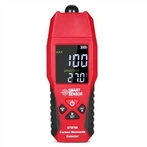
Multimeter current test attachment
Sometimes, the current value you want to measure exceeds the range of the digital multimeter or the on-site conditions do not allow you to open the circuit to measure the current. When testing at high currents (usually greater than 2A) without requiring high accuracy, current clamps are very convenient. The current clamp covers the wire to measure the current and converts it into a value that can be processed by a digital meter.
There are two basic types of current probes: current transformer type, only used for AC measurement. Hall effect probe, used for measuring AC or DC current.
Current converter type. Generally, 1 milliampere is used to represent 1 ampere. A current value of 100 amperes will become 100 milliamperes, which can be easily measured with a digital multimeter. Connect the wires to the "mA" and "Com" sockets, and rotate the function selection knob to the AC milliampere range.
Hall effect probe. Use 1 millivolt to represent the AC or DC value of 1 ampere. For example, a 100 ampere AC current will be converted into a 100 millivolt AC voltage. Connect the test wire to the "V" and "Com" sockets. Rotate the function selection knob to the "V" or "mV" position. At this point, the multimeter uses 1 millivolt voltage to represent 1 ampere of current.
When disconnecting or disassembling a circuit for current measurement, the power supply of the circuit to be tested must be disconnected. Low current can also cause danger.
Do not test the voltage when the test wire is inserted into the current hole. May cause damage to the watch or endanger personal safety.
Transformer type current probe, like the Fluke 80i-400. The digital multimeter uses a display of 1mA to represent the actual 1A signal.