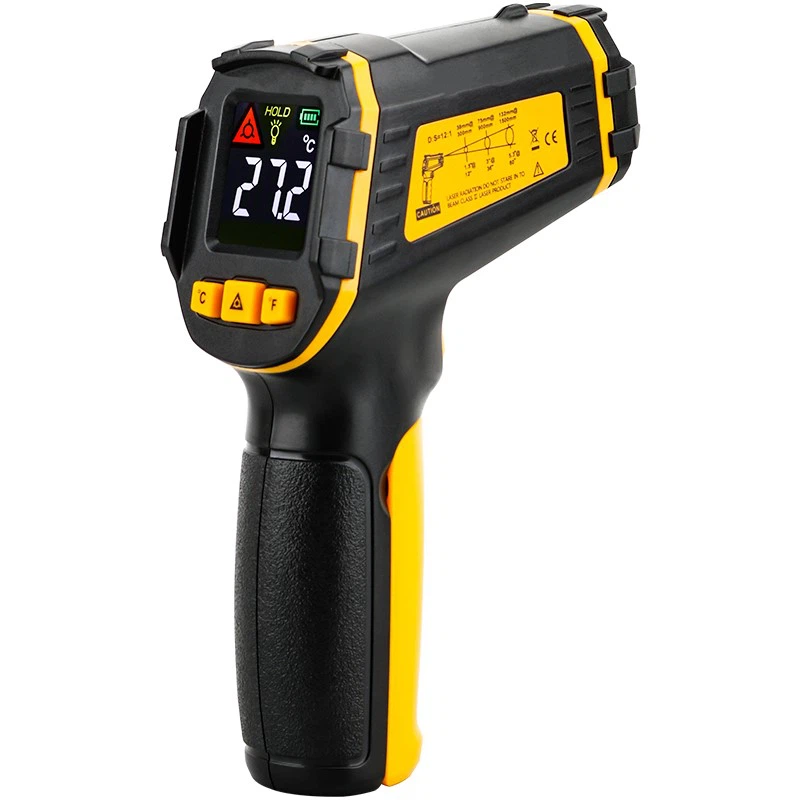
Brief Analysis of Influencing Factors in the Daily Application of Infrared Thermometers
Impact of Atmospheric Attenuation
The infrared radiant energy emitted from the surface of measured electrical equipment travels through the atmosphere to the infrared detection instrument. It is subject to absorption attenuation by gas molecules in the atmosphere, such as water vapor, carbon dioxide and carbon monoxide, as well as scattering attenuation caused by suspended particles in the air.
The attenuation of radiant energy transmission increases with the distance between the detector and the equipment under test, reducing the radiation transmittance of the measured object. Attenuation rises as distance increases. It lowers the radiation contrast between faulty and normal areas of the equipment. Meanwhile, the reduced target energy received by the infrared instrument results in indicated temperatures lower than the actual temperature at the fault point, leading to missed inspections or misdiagnosis. This problem is particularly prominent when detecting equipment faults with minor temperature rises.
As the detection distance increases, the impact of atmospheric conditions becomes more pronounced. To ensure accurate target temperature measurement, inspections should be conducted in dry and clean atmospheric environments. The detection distance should be shortened as much as possible under safe conditions, and reasonable distance correction should be applied to temperature readings to obtain true temperature values.
The distribution network capacitive current tester directly measures capacitive current from the secondary side of the voltage transformer (PT). Capacitive current data can be obtained simply by connecting the measuring wires to the open triangular terminal of the PT.
Humidity sensor probe, stainless steel electric heating tube, PT100 sensor, cast aluminum heater, heating coil, fluid solenoid valve.
Impact of Meteorological Conditions
Adverse weather conditions, including rain, snow, fog and strong winds, adversely affect equipment temperature detection and often cause false fault indications. To minimize meteorological interference, inspections are recommended on rain‑free, fog‑free, windless nights with stable ambient temperatures.
Impact of Ambient and Background Radiation
During infrared inspection of outdoor power equipment, the infrared radiation received by the detector includes not only self‑emitted radiation from the tested components, but also reflections from other equipment parts and the surrounding background, as well as direct solar radiation. Such radiation interferes with the temperature measurement of target areas and introduces errors in fault diagnosis.
To reduce ambient and background radiation interference, field infrared inspection of outdoor electrical equipment should preferably be carried out on cloudy days or after sunset without direct sunlight. This avoids interference from direct, reflected and scattered solar radiation. For indoor equipment, lighting fixtures should be turned off and other radiation sources avoided.
For highly reflective equipment surfaces, effective measures shall be taken to reduce radiation interference from sunlight and surrounding high‑temperature objects, or the detection angle shall be adjusted to the optimal position to avoid reflection.
To mitigate the influence of solar radiation and high‑temperature background sources, appropriate shielding measures may be adopted during detection, or dedicated infrared filters may be installed on infrared measuring instruments to block solar and other background radiation. Select properly configured instruments and a suitable detection distance to ensure the measured area falls within the instrument's field of view, thereby reducing background radiation interference.