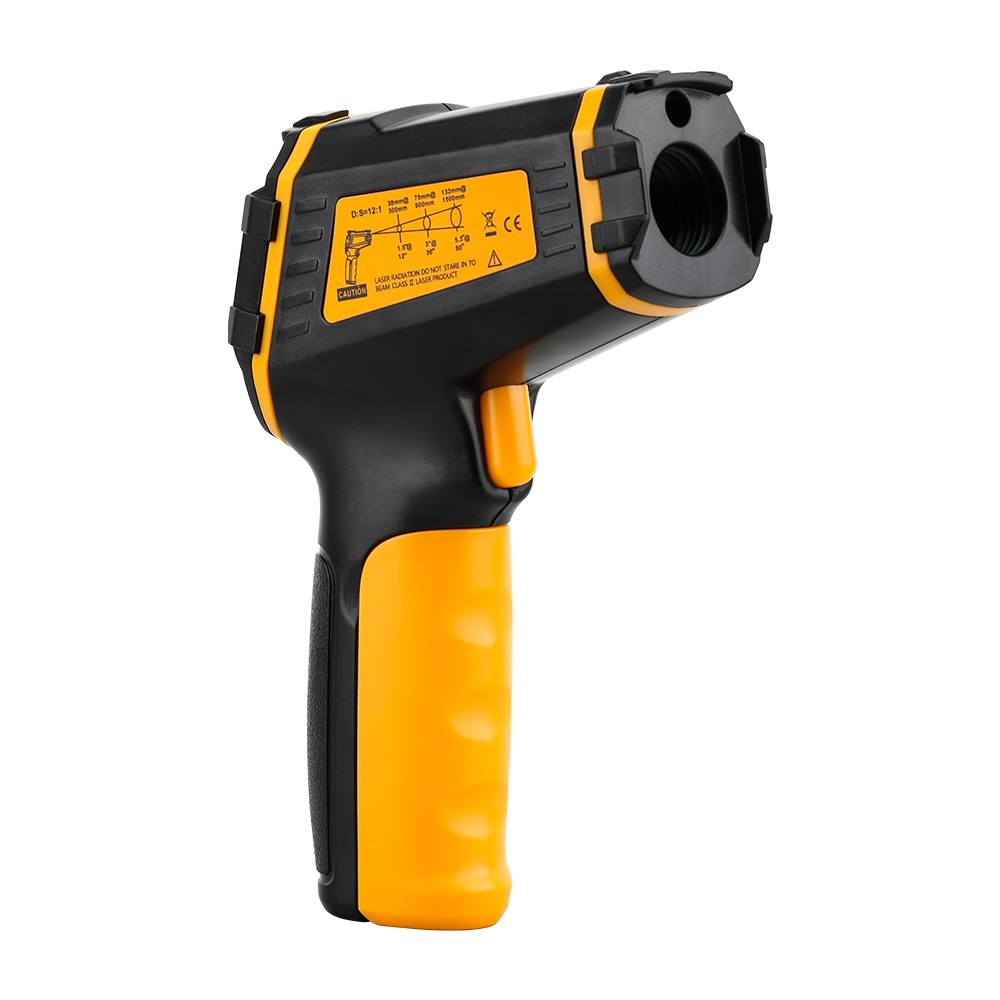
The ratio of measurement distance to target spot size of an infrared thermometer
The optical system of an infrared thermometer collects energy from a circular measuring spot and focuses it onto the detector. Optical resolution is defined as the ratio of the distance from the infrared thermometer to the object to the size of the measured spot (D:S). The higher the ratio, the better the resolution of the infrared thermometer and the smaller the measurable spot size. Laser aiming is used only to assist in targeting the measurement point. The latest advancements in infrared optics have added a near-focus function, enabling precise measurement of small target areas and reducing interference from background temperatures.
Infrared thermometers detect invisible infrared energy naturally emitted by all types of objects. Infrared radiation is part of the electromagnetic spectrum, which also includes radio waves, microwaves, visible light, ultraviolet rays, gamma rays, and X-rays. Infrared radiation lies between visible light and radio waves. Its wavelength is commonly measured in micrometers, ranging from 0.7 μm to 1000 μm. In practical applications, only the spectral band of 0.7 μm to 14 μm is used for infrared temperature measurement.
Infrared thermometers are lightweight, compact, and easy to operate. They enable reliable measurement of high‑temperature, hazardous, or hard‑to‑reach objects without contamination or damage to the measured surface.
Based on working principles, infrared thermometers are classified as single‑color thermometers and two‑color (ratio) thermometers.
For single‑color thermometers, the target area must fully fill the instrument's field of view during measurement. It is recommended that the target size exceed at least 50% of the field of view. If the target is too small, background radiation will enter the optical path and interfere with readings, causing measurement errors. Conversely, if the target is larger than the field of view, background interference outside the measured area will have no impact.
For two‑color thermometers, temperature is determined by the ratio of radiant energy within two independent wavelength bands. Therefore, even when the target is small and cannot fill the field of view, or when smoke, dust, and obstructions attenuate radiation along the measurement path, the impact on results remains minimal. Two‑color thermometers are the ideal choice for tiny, moving, or vibrating targets. Thanks to their slim and flexible optical transmission, radiant energy can be transmitted through curved, blocked, or folded pathways.