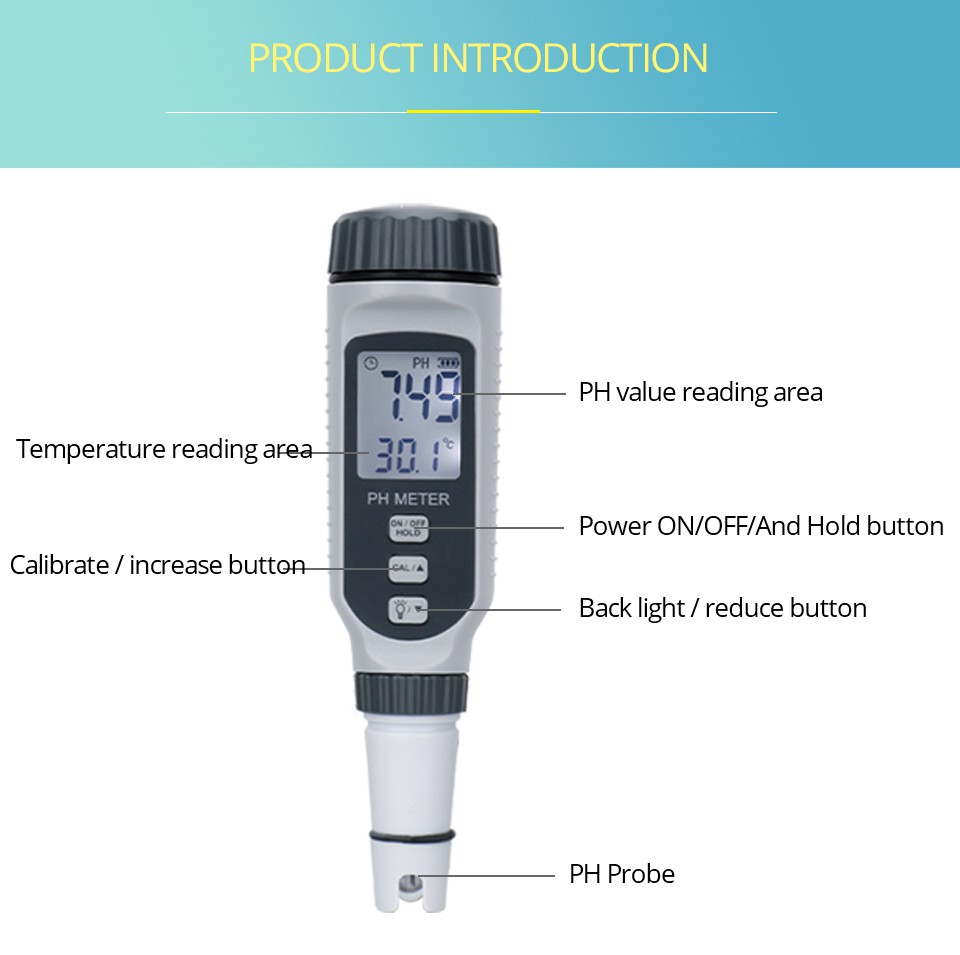
Can the pH value of ultrapure water be measured with a pH meter?
Users who use ultra-pure water machines have this reaction: "Our ultra-pure water has a problem with the pH. It should be ultra-pure water with neutral pH. The result measured by the acidity meter is slightly acidic (or alkaline). What is it? Is there a problem with water quality or something else?"
Usually, we use 18.2MΩ.cm to indicate that the purity of ultrapure water has reached the limit (the total salt concentration is below 1ppb)
10 to the -9th power order of magnitude, relatively small units, similar to ppm, ppt, etc., which are -6 times and -12 times respectively.
Such names are expressed as different normalized quantities depending on the situation −
ppm10-6 (10 to the negative 6th power) is quite microgram level
ppb10-9 (10 to the negative 9th power) is quite nanogram level
ppt10-12 (10 to the negative 12th power) is quite pictorial}
In this case, only 1*10-7 M of [H+] and [OH-] remain in the water and can conduct anion and cation.
At this time, the acid-base change brought about by carbon dioxide→carbonic acid is very interesting. First of all, although the concentration of carbon dioxide in the air is only 0.035% (350ppm), it can produce chemical changes with water, and the reaction is as follows:
CO2(g)+H2O(I)↔H2CO3(I)
Although carbonic acid is a weak acid (Ka1=4.3x10⁻⁷), since there is no dominant relatively strong acid, strong base, conjugate acid, and conjugate base in ultrapure water, carbonic acid is the only dominant Weak acid, and the only source of [H+] ions (neglecting the dissociation of H2O).
Ka1=[H+][HCO3] /[H2CO3]=4.3x10-7
If necessary, we can simulate the situation of carbon dioxide → carbonic acid → carbonate ion in the laboratory. When the ultrapure water starts to be exposed to the atmosphere, the dissolution of carbon dioxide will inevitably continue. At this time, we can There are two ways to monitor this process.
The conductivity will continue to increase. Usually, within one hour, the conductivity will increase from 0.055μS/㎝ (18.2MΩ.㎝) to above 0.25μS/㎝ (below 4MΩ.㎝). Increased to more than 4.5 times.
The pH will continue to drop from 7 (neutral), within about an hour, the pH will drop to 5.7, and will slowly drop to about 4.7 (about two days), with few exceptions.
Of course, judging from this irreversible phenomenon, ultra-pure water should be taken and used immediately. Any long-term storage will not only cause pollution caused by containers, but also pollution caused by dust/volatile organic compounds/microorganisms under the open, carbon dioxide The rise in conductivity and the drop in pH are irresistible.
General pH meters are designed to be used in solutions with high ionic strength, while ultrapure water is a solution with extremely low ionic strength. In fact, there are electrodes and hosts with high sensitivity for low ionic strength solutions on the market. , if this type of instrument is not used, the reading value will jump randomly, which is very difficult to confirm.
The salt bridge is blocked, resulting in the loss of proper function, due to the lack of maintenance of the electrode, and the salt bridge is mostly made of loose and porous ceramic or Teflon material, mainly used for the balance of anions and cations inside and outside the electrode, but due to lack of regular cleaning , in a solution with low ionic strength, the measured pH of ultrapure water is mostly unreasonably high, most of which are around 9~11. If this happens, just add a teaspoon of neutral salt to increase the pH of the ion. The diffusion ability on the salt bridge, with few exceptions, the pH value will drop below pH 7 within a few seconds. In theory, neutral KCl will not change the pH, but only the ionic strength.