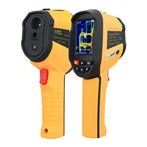
Characteristics and applications of thickness gauges using magnetic and eddy current methods
The coating thickness gauge can non-destructive measure the thickness of non-magnetic coatings on magnetic metal substrates (such as steel, iron, alloys, and hard magnetic steel) (such as aluminum, chromium, copper, enamel, rubber, paint, etc.) and the thickness of non-conductive coatings on non-magnetic metal substrates (such as copper, aluminum, zinc, tin, etc.) (such as enamel, rubber, paint, plastic, etc.).
The coating thickness gauge has the characteristics of small measurement error, high reliability, good stability, and easy operation. It is an essential testing instrument for controlling and ensuring product quality, and is widely used in manufacturing, metal processing, chemical industry, commercial inspection and other testing fields.
Different thickness gauges can be selected according to the measurement needs. Magnetic thickness gauges and eddy current thickness gauges generally measure thicknesses ranging from 0 to 5 millimeters. These instruments are divided into probe and host integrated types, with separate probes and hosts. The former is easy to operate, while the latter is suitable for measuring non planar shapes. Thicker and denser materials need to be measured using an ultrasonic thickness gauge, which can reach a thickness of 0.7-250 millimeters. The electrolytic thickness gauge is suitable for measuring the thickness of metals such as gold and silver electroplated on very thin lines.
The dual-purpose type combines the functions of magnetic thickness gauge and eddy current thickness gauge, and can be used to measure the thickness of coatings on iron and non-iron metal substrates.
Instrument features:
1. Adopting a dual function built-in probe, it automatically identifies iron-based or non iron-based materials and selects the corresponding measurement method for precise measurement.
2. The dual display screen structure, designed in accordance with ergonomics, can read measurement data at any measurement position.
3. Adopting a mobile menu style function selection method, the operation is very simple.
four
The upper and lower limits can be set, and when the measurement result exceeds or meets the upper and lower limit values, the instrument will emit a corresponding sound or flashing light prompt.
5. Extremely stable, usually able to be used for a long time without calibration.
The measurement methods for coating thickness mainly include wedge cutting method, light cutting method, electrolysis method, thickness difference measurement method, weighing method, X-ray fluorescence method, β - ray backscatter method, capacitance method, magnetic measurement method, and eddy current measurement method. The first five of these methods are lossy detection, with cumbersome measurement methods and slow speed, and are mostly suitable for sampling inspection.
With the increasing progress of technology, especially in recent years, with the introduction of microcomputer technology, thickness gauges using magnetic and eddy current methods have taken a step towards miniaturization, intelligence, multifunctionality, high precision, and practicality. The resolution of the measurement has reached 0.1 micrometers, and the accuracy can reach 1%, with a significant improvement. It has a wide range of applications, a wide range, simple operation, and low cost, making it the most widely used thickness measuring instrument in industry and scientific research.