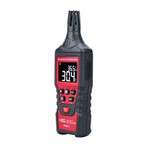
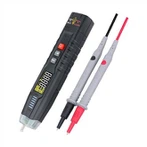
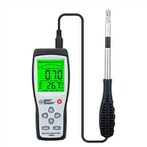
Clamp ammeters are widely used in the electrical field.
Electrical circuit current measurement: A clamp ammeter can directly measure the current of a running electrical circuit without disconnecting the circuit. This makes it have broad application prospects in fields such as power systems, industrial control, and electronic equipment testing.
Fault diagnosis: By measuring the current in the electrical circuit, a clamp ammeter can help engineers quickly locate the fault point. For example, when a motor is running, if the current in one phase is too high or too low, it may be a sign of a problem with the motor winding. At this point, using a clamp ammeter can quickly and accurately identify the problem.
Energy consumption monitoring: Clamp on ammeters can also be used for energy consumption monitoring of household or industrial equipment. By measuring the current of the equipment, its power and energy consumption can be calculated, thereby achieving monitoring and management of energy consumption.
Scientific research: In the field of electrical science research, clamp ammeters also play an important role. For example, in research such as power electronics and electromagnetic field theory, clamp ammeters can be used to measure various electrical parameters and waveform characteristics.
Advantages and limitations of clamp current meter
As an electrical measuring tool, the clamp ammeter has the following advantages:
Non contact measurement: A clamp ammeter can measure current without disconnecting the circuit, avoiding potential safety hazards and inconvenience caused by circuit disconnection.
Convenient and fast: The clamp ammeter is compact, lightweight, easy to carry and operate, and can quickly and accurately complete current measurement tasks.
Widely used: Clamp on ammeters are suitable for current measurement tasks in various electrical circuits, including DC, AC, high-frequency, and other types of currents.
However, clamp current meters also have certain limitations:
Limited accuracy: The accuracy of clamp ammeters is usually not as high as traditional ammeters, typically ranging from 2.5 to 5 levels. Therefore, in situations where high-precision measurements are required, other types of ammeters may need to be used.
Limited measurement range: The measurement range of a clamp ammeter is affected by its internal structure and range limitations, making it unable to measure excessive currents. In addition, there are certain difficulties in measuring small currents.
Susceptible to interference: Clamp on ammeters are easily affected by external magnetic fields, electromagnetic interference, and other factors during the measurement process, resulting in measurement errors. Therefore, it is important to avoid interference from these factors when using it.