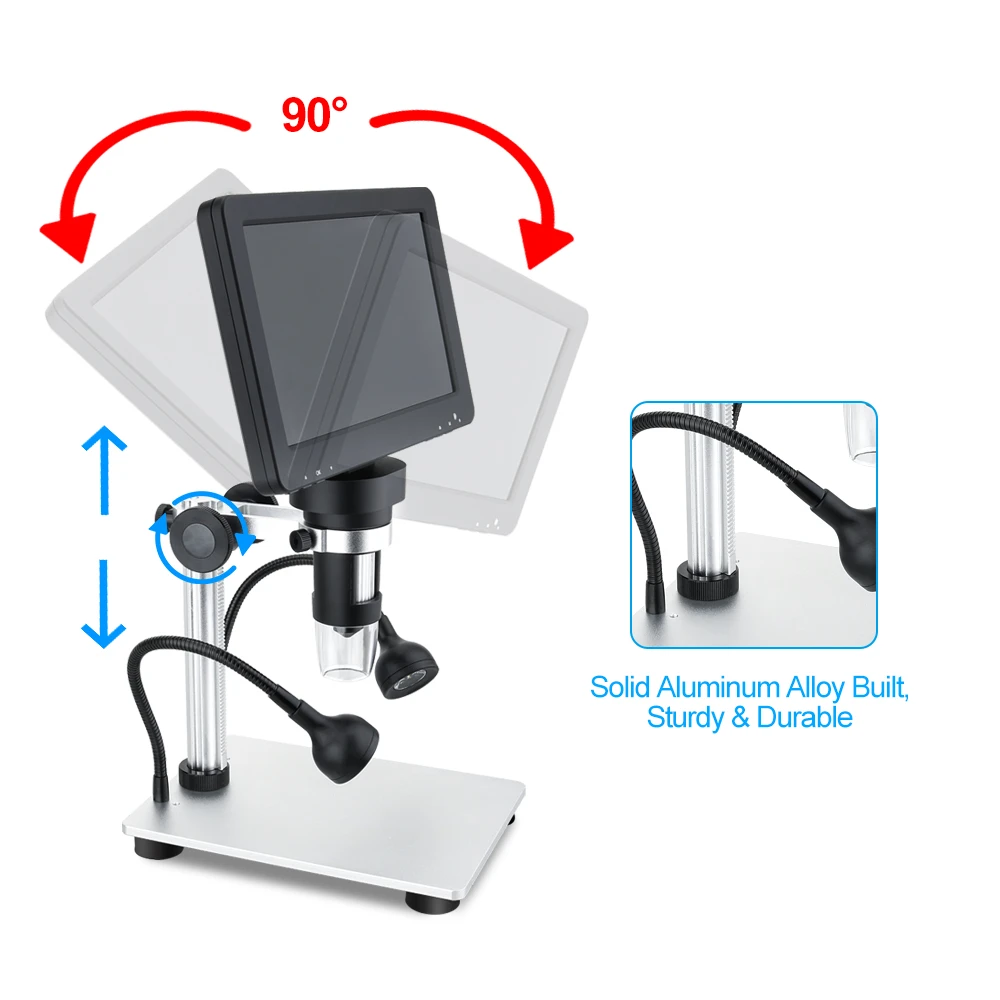
Comparison Between Digital Microscopes and Conventional Microscopes
Digital microscopes, also known as video microscopes, photographic microscopes, CCD microscopes, have various aliases. A digital microscope integrates a traditional optical microscope with a video camera lens. In other words, it adds an imaging device, either a digital camera or a microscope camera, to an ordinary optical microscope. It converts the real object image viewed under the microscope via digital-to-analog conversion and displays the image on a computer. As a high-tech product, it elaborately combines sophisticated optical microscopy technology, advanced photoelectric conversion technology and common television technology.
It transforms microscopic research from traditional binocular observation to image reproduction on a display, greatly improving work efficiency. It is mainly used for teaching purposes.
The primary advantage of digital microscopes is that conventional optical microscopes can only be operated by one user. It is difficult to share microscopic images, and special equipment is usually required to capture images inside the microscope. In contrast, digital microscopes can be connected to a computer. Microscopic images can be transmitted to classroom projectors for playback, allowing all students in the classroom to view the images simultaneously, which also facilitates classroom management.
Digital microscopes reduce eye strain, capture and save observed images. They enable multi-user preview at low cost and support multiple functions including measurement, printing and photography.
There are six major differences between digital microscopes and conventional microscopes:
① It features microscopic video recording. Observed microscopic results can be saved as image-text files for circulation among relevant departments. Conventional microscopes only allow observation through eyepieces and cannot record microscopic videos.
② It can connect to a computer to realize simultaneous observation by multiple people, while conventional microscopes are limited to single-person observation.
③ Preview via computer screen reduces eye fatigue. Users of conventional microscopes must continuously observe through eyepieces, which tends to cause excessive eye strain.
④ The imaging unit of a digital microscope supports measurement, image-text report printing, video recording and other functions. Conventional microscopes only support simple microscopic observation.
⑤ Digital microscopes mark a new era in the development of modern scientific instruments. They possess many functions unavailable on conventional microscopes and have achieved rapid development in scientific research, product inspection, teaching demonstration, archaeology and other fields.