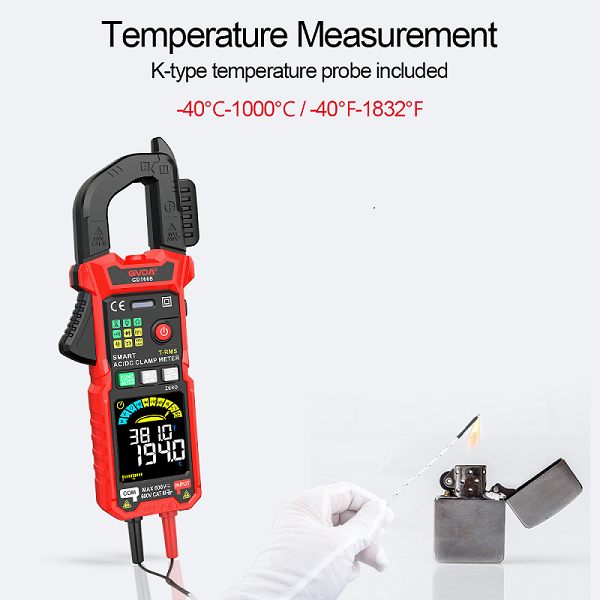
Current clamp structure and principle
A clamp meter is essentially composed of a current transformer, a clamp wrench, and a rectifying magneto electric system reactive force instrument.
Structure of AC clamp ammeter
1. Ammeter; 2- Current transformer; 3- Iron core; 4-Handle, 5-Secondary winding; 6-Tested wire; 7-Range switch)
The working principle of a clamp type meter is the same as that of a transformer. The primary coil is a wire that passes through a clamp type iron core, equivalent to the primary coil of a 1-turn transformer, which is a step-up transformer. The secondary coil and the ammeter used for measurement form a secondary circuit. When an alternating current passes through a wire, it is this coil that generates an alternating magnetic field, causing an induced current in the secondary circuit. The ratio of the current to the primary current is inversely proportional to the number of turns in the primary and secondary coils. Clamp type ammeter is used to measure high currents. If the current is not large enough, the primary wire can be passed through the clamp type ammeter by increasing the number of turns, and the measured current can be divided by the number of turns. The secondary winding of the through type current transformer of the clamp ammeter is wound around the iron core and connected to the AC ammeter, and its primary winding is the measured wire passing through the center of the transformer. The knob is actually a range selection switch, and the function of the wrench is to open and close the movable part of the core of the through type transformer, so as to clamp it into the tested wire. It is organized by Beijing Ocean Xingye Technology Co., Ltd.
When measuring current, press the wrench, open the clamp, and place the measured current carrying wire in the middle of the through type current transformer. When an alternating current passes through the measured wire, the magnetic flux of the alternating current induces a current in the secondary winding of the transformer. This current passes through the coil of the electromagnetic ammeter, causing the pointer to deflect and indicating the measured current value on the dial scale.