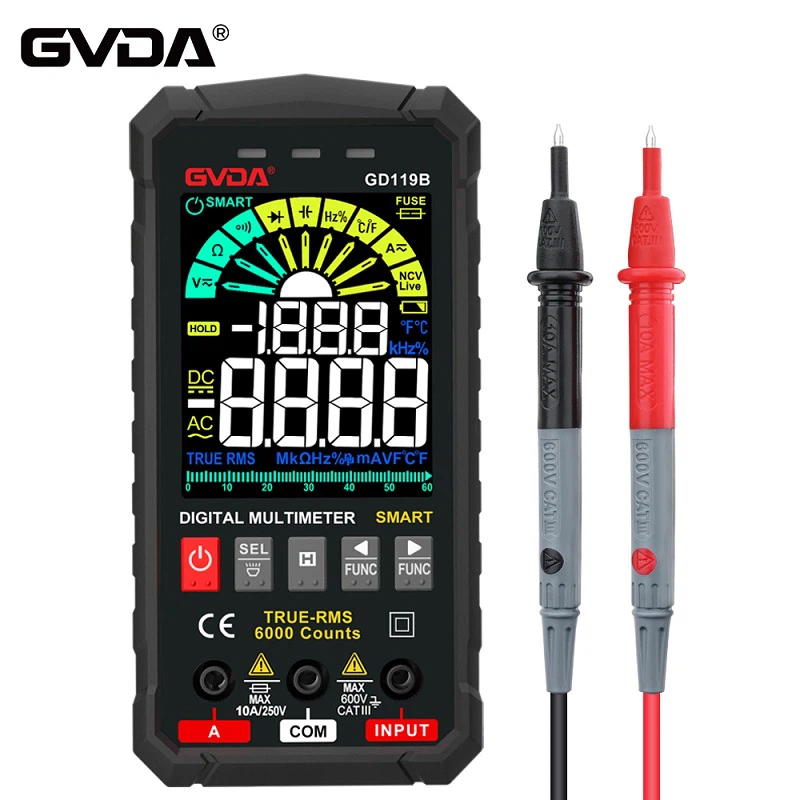
Detection of faulty capacitors is usually done using a multimeter.
1. Fault detection of non-polar capacitors:
When testing, first mechanically zero the pointer multimeter. Then select the Rx10k ohm range of the multimeter, and touch the red and black probes of the meter to the two pins of the capacitor to be tested, observing the change in the resistance value indicated by the multimeter.
If the pen is connected instantly, the pointer swings slightly to the right and then returns to infinity; After replacing the probe and measuring again, if the pointer still swings slightly to the right and returns to infinity at the moment the probe is connected, it indicates that the capacitor is normal.
If the pointer of the multimeter swings to the right near 0 at the moment of connection, it indicates that the capacitor is severely leaking or has been broken down.
If the pointer of the multimeter cannot return to infinity after swinging to the right at the moment of connection, it indicates that the capacitor is leaking electricity.
If the pointer of the multimeter does not move at the moment of connection, it indicates that the capacitor is open circuit.
2. Fault detection of electrolytic capacitors:
Electrolytic capacitors are polarized capacitors. Before testing, use a screwdriver or a straight line to discharge the remaining charge in the capacitor. Then connect the black probe of the multimeter to the positive terminal of the capacitor and the red probe to the negative terminal, and observe the oscillation of the meter pointer.
At the moment of initial connection, the multimeter should deflect to the right by a significant angle and then return to the left. Until it stops at a certain point, the measured resistance value is the forward insulation resistance of the capacitor. The resistance measured after swapping the probes is the reverse insulation resistance of the capacitor.
If the pointer of the meter does not move, it indicates that the capacitance of this capacitor has disappeared or there is an internal circuit break.
If the meter measures that the forward and reverse insulation resistance of the capacitor is very small or zero, it indicates that the capacitor has a large leakage or internal short circuit.
Place the digital multimeter in the capacitor range and select the appropriate range based on the amount of electricity. After the tested capacitor is fully discharged, directly plug the two pins of the capacitor into the test hole for measurement; Alternatively, use two probes to directly touch the capacitor pin for measurement, and the capacity of the measured capacitor will be displayed directly on the multimeter.
When measuring an electrolytic capacitor with a digital multimeter, after fully discharging the capacitor to be measured, the red probe of the meter should be connected to the positive pole of the capacitor and the black probe should be connected to the negative pole of the capacitor. At this point, the measured positive insulation resistance of the capacitor is obtained, and vice versa, the measured resistance is the negative insulation resistance.
Substitution techniques for capacitors:
1. The capacity of the substitute capacitor should be basically the same as that of the original capacitor.
2. High voltage capacitors can replace low voltage capacitors, but low voltage capacitors cannot replace high voltage capacitors.
3. Parallel connection of small capacity capacitors can replace large capacity capacitors; Large capacity capacitors in series can replace small capacity capacitors.
4. Electrolytic capacitors in reverse series can be used to replace non-polar capacitors.
5. For high-frequency oscillation capacitors and power filter capacitors, ordinary capacitors cannot be used as substitutes.