Differences between analogue and digital oscilloscopes
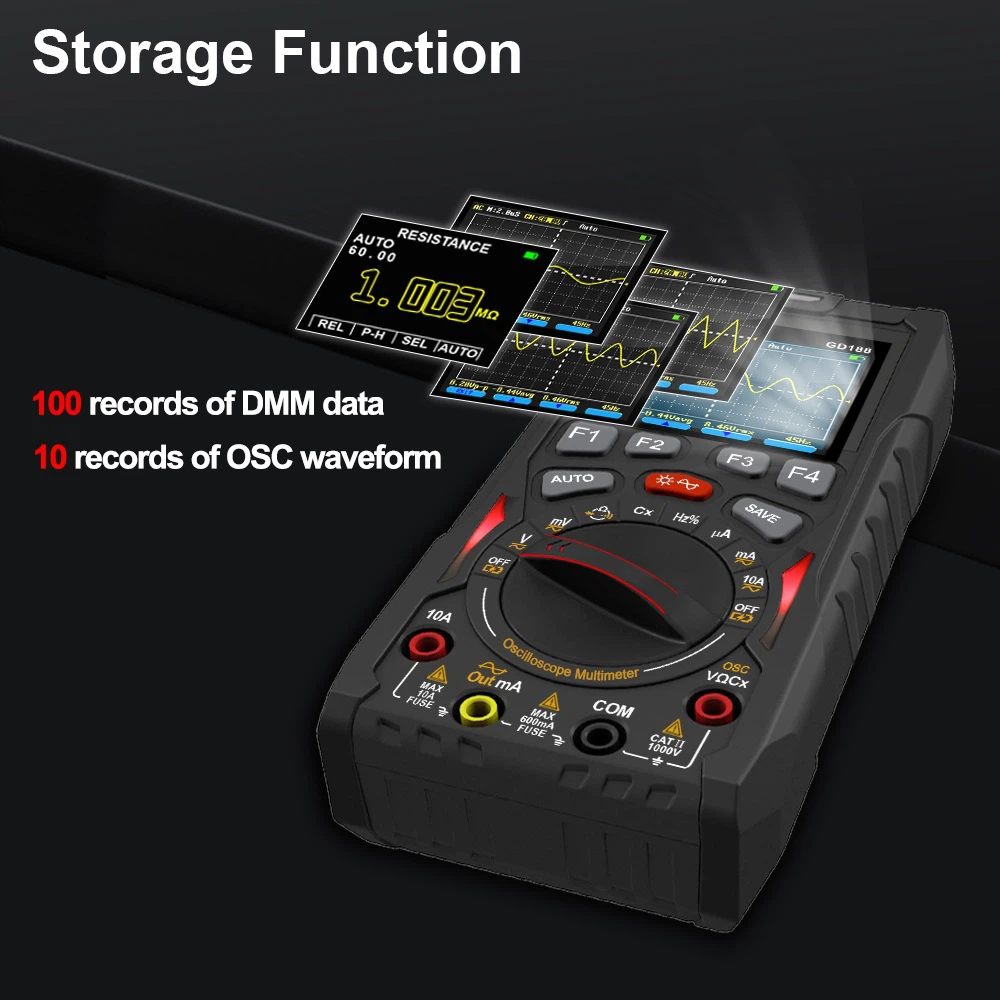
Oscilloscope is a very widely used electronic measuring instruments. It can be invisible to the naked eye electrical signals into visible images, to facilitate the study of various electrical phenomena in the process of change. The use of oscilloscopes can observe a variety of different signal amplitude over time waveform curve, you can also use it to test a variety of different quantities, such as voltage, current, frequency, phase difference, amplitude adjustment and so on.
Oscilloscopes can be divided into analogue oscilloscopes and digital oscilloscopes.
Analogue oscilloscope
Analogue oscilloscopes work by measuring the signal voltage directly and depicting the voltage vertically by passing the electron beam across the oscilloscope screen from left to right.
Digital Oscilloscopes
Digital oscilloscopes work by converting the measured voltage into digital information through an analogue converter (ADC). The digital oscilloscope captures a series of samples of the waveform and stores the samples up to the limit of whether the accumulated samples can depict the waveform, after which the digital oscilloscope reconstructs the waveform.
Analogue oscilloscopes to improve the bandwidth, you need to oscilloscope, vertical amplification and horizontal scanning full advance. To improve the bandwidth of digital oscilloscopes, only the performance of the front-end A/D converter needs to be improved, and there are no special requirements for the oscilloscope and scanning circuit. Plus, digital oscilloscopes can take full advantage of memory, storage and processing, as well as multiple triggering and over-triggering capabilities. In the 1980s, digital oscilloscopes rose to prominence, and the results have been numerous, with the trend of comprehensively replacing analogue oscilloscopes, analogue oscilloscopes do retreat from the foreground to the background.
Word oscilloscopes first in the sampling rate to improve, from the initial sampling rate equal to twice the bandwidth, increased to five or even ten times, the corresponding sampling of sinusoidal wave introduced distortion is also reduced from 100% to 3% or even 1%. Bandwidth of 1GHz sampling rate is 5GHz, or even 10GHz.
Secondly, to improve the update rate of digital oscilloscopes, analogue oscilloscopes to reach the same level, up to 400,000 waveforms per second, the observation of episodic signals and capture the burr pulse is much more convenient.
For most electronic applications, both analogue and digital oscilloscopes are competent, only for some specific applications, due to the different characteristics of analogue and digital oscilloscopes have, there will be suitable and unsuitable places. Each step of the oscilloscope, there will be certain characteristics, there are some shortcomings, in the selection of models should pay attention to the comparison.