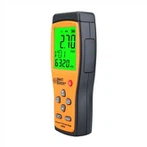
Differences between different thickness gauges
Instruments used to determine the thickness of the material itself or the thickness of the material surface covering layer. Some components in the manufacture and maintenance must be measured when the thickness, in order to understand the thickness of the material specifications, the uniformity of each point and material corrosion, wear and tear; sometimes to determine the thickness of the material surface covering layer, in order to ensure product quality and production safety. According to the principle of determination of different, commonly used thickness gauge ultrasonic, magnetic, eddy current, isotope and so on four kinds.
Ultrasonic thickness gauge ultrasonic sound speed in various media is different, but in the same medium the speed of sound is a constant. Ultrasonic propagation in the medium will be reflected when encountering the second medium, measuring the ultrasonic pulse from the launch to the reception of the interval time, you can convert this interval time into thickness. Commonly used in the determination of boiler barrel, heated surface pipe, pipeline thickness, also used for verification of the structure of the workpiece size, etc.. This kind of thickness gauge is mostly portable, the volume and small semiconductor radio is similar, the thickness value of the display is mostly digital. For steel, the maximum determination of the thickness of 2000 mm or so, the accuracy of ± 0.01 ~ ± 0.1 mm between.
Magnetic thickness gauge in the determination of a variety of magnetically conductive materials in the magnetoresistance, the measured value will be due to the thickness of the surface of the non-conducting magnetic cover layer of different changes. This change can be used to measure the thickness of the cover layer. Commonly used in the determination of ferromagnetic metal surface spray aluminium layer, plastic layer, electroplating layer, phosphating layer, paint layer thickness.
Eddy current thickness gauge when the probe coil containing high-frequency current is placed on the metal surface being measured, due to the role of high-frequency magnetic field and make the metal body produces eddy current, this eddy current produces a magnetic field and counter-acting in the probe coil, so that its impedance changes, the amount of this change and the probe coil away from the distance from the metal surface (i.e., the thickness of the cover layer), and thus according to the changes in the impedance of the probe coil can be indirectly measured by the cover layer on the surface of the metal. Thickness. Commonly used in the determination of the oxide film on the aluminium or aluminium, copper surface thickness of other insulating cover layer.
Isotope thickness gauge using material thickness of different radiation absorption and scattering of different principles, you can determine the thickness of thin steel plate, thin copper plate, thin aluminium plate, silicon steel sheet, alloy sheet and other metal materials and rubber sheet, plastic film, paper and so on. Commonly used isotope rays are γ rays, β rays and so on.