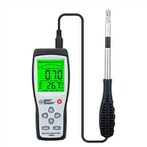
Digital multimeters' primary indications, display digits, and display features
The display digits of a digital multimeter are usually 3 1/2 to 8 1/2 digits. There are two principles for judging the display digits of digital instruments: one is that the digits that can display all numbers from 0 to 9 are integer digits; The numerator is the numerator, and the count value is 2000 when the full scale is used, which indicates that the instrument has 3 integer digits, and the numerator of the fractional digit is 1, and the denominator is 2, so it is called 3 1/2 digits, read as "three and a half digits ", the highest bit can only display 0 or 1 (0 is usually not displayed). 3 2/3 digits (pronounced "three and two-thirds digit"), the highest digit of the digital multimeter can only display numbers from 0 to 2, so the maximum display value is ±2999. Under the same conditions, it is 50% higher than the limit of a 3 1/2 digit digital multimeter, which is especially valuable when measuring 380V AC voltage.
Popular digital multimeters generally belong to hand-held multimeters with 3 1/2 digits display, and 4 1/2, 5 1/2 digits (less than 6 digits) digital multimeters are divided into two types: handheld and desktop. More than 6 1/2 digits mostly belong to desktop digital multimeters.
The digital multimeter adopts advanced digital display technology, with clear and intuitive display and accurate reading. It not only ensures the objectivity of the reading, but also conforms to people's reading habits, and can shorten the reading or recording time. These advantages are not available in traditional analog (ie pointer) multimeters.
Accuracy (Precision)
The accuracy of a digital multimeter is a combination of systematic and random errors in the measurement results. It indicates the degree of agreement between the measured value and the true value, and also reflects the size of the measurement error. Generally speaking, the higher the accuracy, the smaller the measurement error, and vice versa.
Digital multimeters are far more accurate than analog analog multimeters. The accuracy of the multimeter is a very important indicator. It reflects the quality and process capability of the multimeter. It is difficult for a multimeter with poor accuracy to express the real value, which may easily cause misjudgment in measurement.
Resolution (resolution)
The voltage value corresponding to the last digit of the digital multimeter on the lowest voltage range is called resolution, which reflects the sensitivity of the meter. The resolution of digital digital instruments increases with the increase of display digits. The highest resolution indicators that digital multimeters with different digits can achieve are different.
The resolution index of the digital multimeter can also be displayed by resolution. Resolution is the percentage of the smallest number (other than zero) that the meter can display to the largest number.
It should be pointed out that resolution and accuracy belong to two different concepts. The former characterizes the "sensitivity" of the instrument, that is, the ability to "recognize" tiny voltages; the latter reflects the "accuracy" of measurement, that is, the degree of consistency between the measurement result and the true value. There is no necessary connection between the two, so they cannot be confused, and the resolution (or resolution) should not be mistaken for similarity. Accuracy depends on the comprehensive error and quantization error of the internal A/D converter and functional converter of the instrument. From the perspective of measurement, resolution is a "virtual" indicator (which has nothing to do with measurement error), and accuracy is a "real" indicator (it determines the size of measurement error). Therefore, it is not possible to arbitrarily increase the number of display digits to improve the resolution of the instrument.