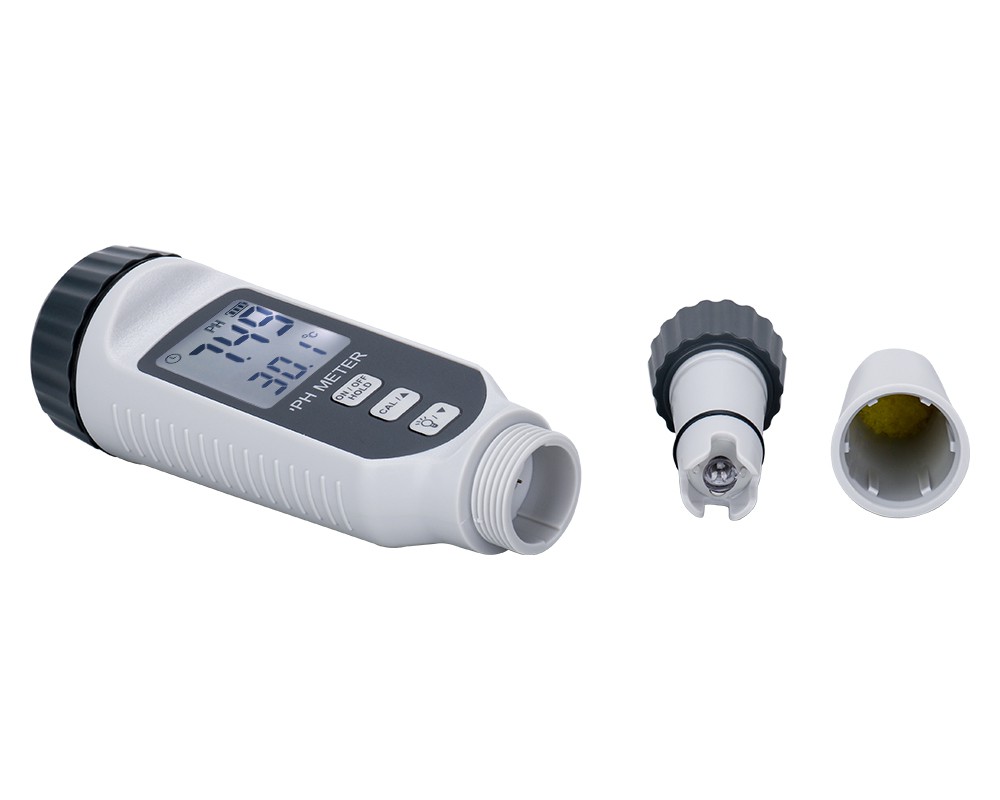
Does temperature have a great influence on pH accuracy measurement?
For pH electrodes, temperature affects each pH by 0.003pH/°C. For example, a 0.2-grade pH meter is calibrated in a 30°C pH buffer and then tested at 60°C (assuming that the pH range of the solution is between pH 6 and 8). There is a difference between pH7.00 and pH7.00 by one pH unit), then the maximum error affected by temperature is 30×0.003=0.09pH. If it is 3 pH units (within the pH range of 4-10), the maximum error is 0.27pH, from which it can be seen that the temperature has a great influence on the pH. Of course, we can also draw conclusions from it. In order to reduce the error of temperature to pH measurement, we should pay attention to the following three points:
(1) Try to select a buffer solution close to the pH value of the solution to be measured to calibrate the pH meter.
(2) Try to make the temperature of the calibration solution consistent or close to the temperature of the measured solution.
(3) A pH meter with temperature compensation should be selected.
pH meters with an accuracy higher than 0.1pH have temperature compensation adjustments, while pH meters with a grade of 0.2 do not have temperature compensation. Some 0.2-grade pH meters also claim to have 0.1-grade accuracy. In fact, this is impossible. Some people confuse the two concepts of resolution 0.1pH and precision 0.1pH. Even in terms of one pH unit, the pH error at a distance of 60°C is 0.003×60=0.18pH. Therefore, the highest accuracy of a pH meter without temperature compensation is only 0.2pH.
Does temperature compensation remove all temperature-induced errors?
It must be pointed out that the temperature compensation set on the pH meter is only the slope item (2.303RT/F) of the compensation electrode. Also affected by the temperature are the standard potential of the glass electrode, the liquid junction potential, etc., which are not strictly linear with the temperature. At the same time, it takes a certain amount of time for the pH electrode to reach equilibrium at the new temperature. Therefore, neither manual temperature compensation nor automatic temperature compensation is sufficient. According to the operational definition of pH measurement, in order to obtain precise measurement results, the sample solution and the standard solution should be measured at the same and constant temperature, which is the principle of isothermal measurement. For pH measurement with general accuracy requirements, temperature compensation can be used when the temperature of the sample solution is different from that of the standard solution.