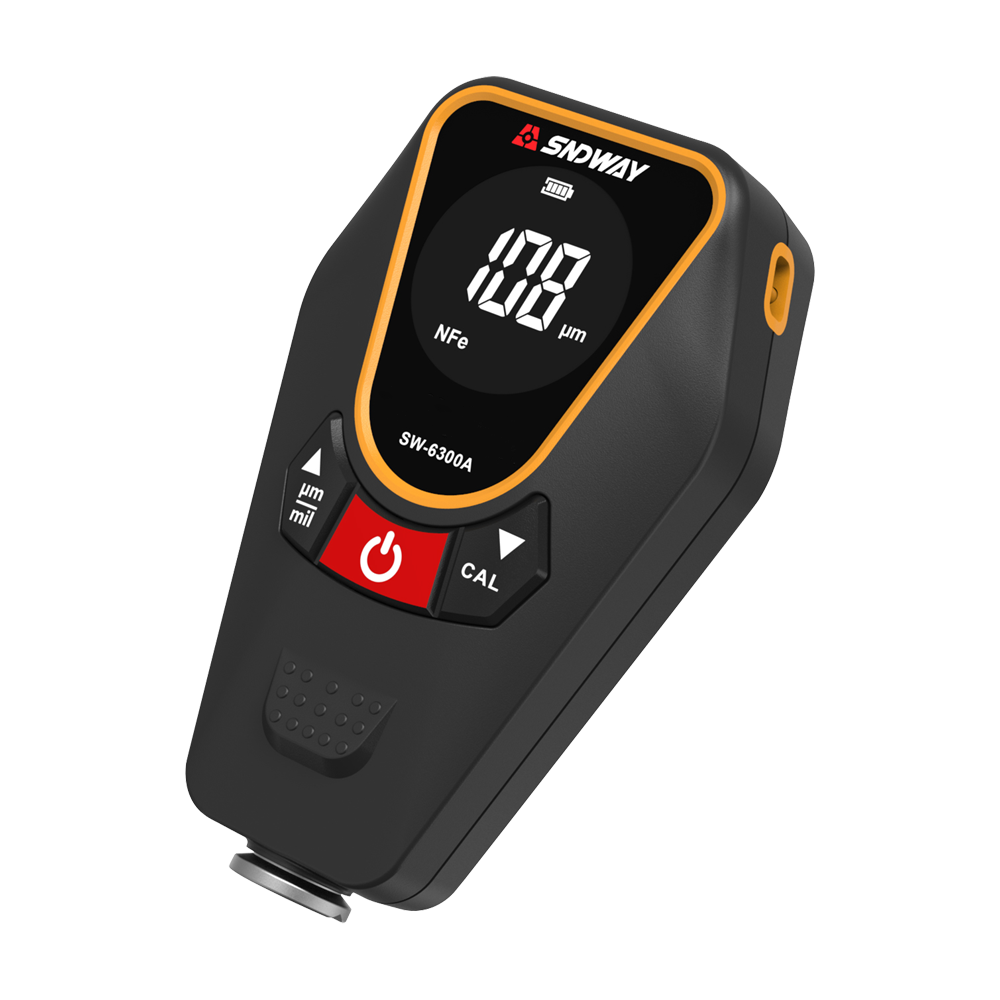
Eddy Thickness Gauge Flow Measurement Principle
The high-frequency AC signal generates an electromagnetic field in the probe coil, and when the probe is close to the conductor, eddy currents are formed in it. The closer the probe is to the conductive substrate, the greater the eddy current and the greater the reflected impedance. This feedback action represents the distance between the probe and the conductive substrate, that is, the thickness of the non-conductive coating on the conductive substrate. Since this type of probe is specifically designed to measure the thickness of coatings on non-ferromagnetic metal substrates, it is often called a non-magnetic probe. Non-magnetic probes use high-frequency materials as the coil core, such as platinum-nickel alloy or other new materials. Compared with the principle of magnetic induction, the main difference is that the probe is different, the frequency of the signal is different, and the size and scaling relationship of the signal are different. Like the magnetic induction thickness gauge, the eddy current thickness gauge also reaches a high level of resolution of 0.1um, allowable error of 1%, and measuring range of 10mm.
Thickness gauges using the eddy current principle can, in principle, measure non-conductive coatings on all conductive bodies, such as paint, plastic coatings on the surface of aerospace aircraft, vehicles, home appliances, aluminum alloy doors and windows, and other aluminum products. Anodized film. The cladding material has a certain conductivity, which can also be measured through calibration, but the ratio of the conductivities between the two is required to be at least 3-5 times different (such as chromium plating on copper). Although the steel matrix is also a conductor, it is more appropriate to use the magnetic principle for this type of task.