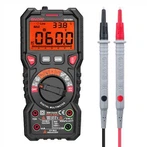
Emergency Measurement of On-line Resistance with a Digital Multimeter
The following points should be noted when using a digital multimeter for emergency measurement of online resistance using the load and voltage drop measurement method:
(1) The full-scale test voltage and open circuit voltage of different models of digital multimeters with different resistance ranges are different, so the range of values for loading resistor R1 should be determined by experiments.
(2) When operating, the load resistor R1 should be connected between the V/Ω of the digital multimeter and the COM socket, and the measured value of R1 should be read out by the digital multimeter in that resistance range before conducting online resistance measurement. It is not possible to connect the tested circuit in parallel with resistor R1 first, as this will cause the silicon transistor in the tested circuit to become conductive due to the high test voltage of the digital multimeter's resistance mode, resulting in significant measurement errors. So, this order cannot be reversed.
(3) Due to the fact that the resistance values of resistors connected in parallel with the emitter and collector junctions of transistors in general circuits are mostly between k Ω and several hundred k Ω, and few tens of ohms, the digital multimeter is usually set to the middle block, that is, the 200k Ω range (with a resolution of 0.1k Ω) or the 20k Ω range, when measuring online. If R=R1. RX/(R1+RX) is measured to be O or very small, it indicates that the tested circuit has a short circuit fault (RX=0) or a high range. At this time, low blocking (2k Ω gear) should be used for fine measurement. If R=R1. RX/(R1+RX) is very close to R1, it indicates that the tested circuit may have an open circuit fault (RX=∞) or a low range, and should be retested with a high impedance (2W Ω).
(4) Online measurement generally rarely uses the 200 Ω resistor range and 20M Ω range. Because loading resistor R1 in parallel with the measured resistor RX actually expands the measurement range of the resistance range and improves the ability to measure high resistance, generally using a 2M Ω range is sufficient. In addition, since the resolution of the 2k Ω gear is 1 Ω, it is sufficient to use this gear to determine whether there is a short circuit breakdown in the online transistor without a circuit. In general, not only three loaded resistors can meet the needs of measuring online resistance. Taking the DT830A digital multimeter as an example, the 2k Ω range is set to R1=R0=1k Ω, the 200k Ω range is set to R1=0.47RO=47k Ω, and the 2M Ω range is set to R1=0.47R0=470k Ω. Of course, we can also use a 470k Ω potentiometer to replace the three loading resistors mentioned above.
(5) After measuring the online resistance, do not take note to promptly remove the load resistor R1 that is connected between the V/Ω of the digital multimeter and the COM socket to avoid affecting the normal use of the multimeter and causing accidents (when measuring high voltage).