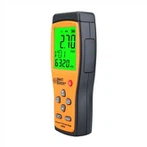
Emissivity Parameters and Working Principle of Infrared Thermometer
Infrared thermometer is a non-contact temperature measuring device widely used in industrial, medical, scientific research and other fields. It can quickly and accurately measure the surface temperature of target objects without direct contact, and has the advantages of high efficiency, safety, and convenience. In infrared thermometers, emissivity parameters and working principles are key components. Let's take a detailed look below.
1, Emissivity parameter
Emissivity refers to the ability of an object's surface to radiate infrared energy, typically ranging from 0 to 1. For objects made of different materials, their surface radiation capabilities vary, so infrared thermometers need to consider the emissivity of the object when measuring its temperature.
2, Theoretical emissivity
The theoretical emissivity of an object refers to the radiation ability of its surface in a completely blackbody radiation state, also known as absolute emissivity. The range of theoretical emissivity is 0 to 1, and the theoretical emissivity of a complete blackbody is 1, which means that all radiated energy is emitted.
3, Actual emissivity
Due to the difficulty of absolute blackbody in practice, the emissivity of an object's surface is usually represented by its actual emissivity. The actual emissivity takes into account factors such as reflection and transmission on the surface of the object, and the range of values is also between 0 and 1.
When measuring the temperature of an object, an infrared thermometer will set corresponding emissivity parameters based on the material characteristics and temperature range of the object to ensure the accuracy of temperature measurement.
4, Working principle
Infrared thermometers determine the temperature of an object by measuring the infrared radiation energy emitted from its surface based on its thermal radiation characteristics. Its working principle mainly includes the following steps:
1. Infrared sensing
The infrared thermometer receives infrared radiation energy emitted from the surface of the target object through a built-in infrared sensor.
2. Signal processing
After receiving infrared radiation energy, the infrared thermometer will process the signal, filter out interference and noise, to ensure the accuracy of the measurement.
3. Calculate temperature
After signal processing, the infrared thermometer calculates the temperature using pre-set emissivity parameters and measured infrared radiation energy, and displays the measured temperature value on the display screen.
4. Temperature measurement range and accuracy
Infrared thermometers typically have a wide temperature measurement range and high accuracy. Different models of thermometers can adapt to different application scenarios, achieving precise measurements from low to high temperatures, from room temperature to extreme temperatures.