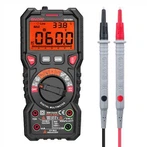
Error Analysis of Voltage Measurement by Digital Multimeters and Analog (Pointer) Multimeters
If the measured voltage is the mains electricity, that is, an alternating current with a frequency of 50Hz, and both multimeters are qualified, it can only indicate that the internal resistance of the measured voltage is too high. Under the same frequency, the biggest factor affecting the voltage measurement results of an analog (pointer) multimeter and a digital multimeter is the difference in internal resistance, which is quite large and not in the same order of magnitude. When the internal resistance of the measured voltage is small, the difference is not obvious. When the internal resistance of the measured voltage is large, the measurement results will vary greatly.
In this case, it is possible that the measured voltage is not the actual 220V live wire power supply line, or it is the voltage measured after the live wire passes through some kind of electrical appliance, or it is the voltage of the leakage shell of the electrical appliance.
Excluding the above possibilities, it can only indicate that one of the two multimeters is inaccurate and needs to be repaired and calibrated.
When there is an error in voltage measurement, first of all, you need to figure out what the frequency of the measured alternating voltage is in Hz? Is this voltage a pure sine wave?
For various multimeters currently on the market, their instruction manuals all indicate the frequency response range and alternating current waveform of the multimeter when measuring alternating voltage. For various ordinary digital multimeters, their frequency response is generally 40-1000Hz, and a sine wave (with a distortion degree ≤ 1%) is required. The measurement accuracy of the measured alternating voltage beyond the above range is not guaranteed. This is because the AC/DC (alternating current/direct current) conversion circuits inside most digital multimeters are basically designed using the low-power dual operational amplifier TL062. The GBW (gain bandwidth product) of this operational amplifier is limited, so digital multimeters cannot measure high-frequency alternating voltages (of course, it is also related to whether the voltage dividing resistors of the multimeter have compensation).
As for general analog (pointer) multimeters (which were first invented by Americans and have a history of 100 years), their internal structure is quite simple. Inside, there is just a high-sensitivity meter head + diode rectification + voltage dividing resistors (in order to improve sensitivity, a few analog multimeters add an AC amplifier composed of an operational amplifier between the meter head and the voltage dividing resistors). Therefore, the measurement accuracy of this kind of old and inexpensive multimeter simply cannot be compared with that of digital multimeters. Generally, the voltage dividing resistors of this kind of multimeter do not have capacitance compensation, so their frequency response is generally 40-400Hz.
If the difference in measuring the same alternating voltage between the two multimeters is dozens of volts, first of all, you need to check their voltage dividing resistor networks to see if the value of any resistor has changed. If everything is normal, for the analog multimeter, you can also check whether the pointer of its meter head can point to the zero position. For the digital multimeter, you can check whether the calibration potentiometer of its AC voltage range is loose.
Incidentally, if you want to accurately measure the alternating voltage of any waveform, it is recommended to purchase a true root mean square (TRMS) multimeter. This kind of multimeter can accurately measure the alternating voltages of various waveforms such as sine waves, triangular waves, and rectangular waves, and it has nothing to do with the distortion degree.