Fusing Resistor Measurement with Multimeter
A fusing resistor is a special component that serves the dual purpose of a resistor and a fuse. It is represented in the circuit by the letters "RF" or "R".
Selection of Fusing Resistors
Selection should take into account its dual performance, according to the specific requirements of the circuit to select its resistance and power and other parameters. Both to ensure that it can quickly fuse in overload, but also to ensure that it can work under normal conditions for a long time and stable. Resistance value is too large or too much power, can not play a protective role.
Detection of fusing resistor with a multimeter measurement method
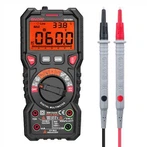
In the circuit, when the fuse is open, you can make a judgement based on experience: if you find the surface of the fusing resistor black or burnt, it can be concluded that it is overloaded, the current through it is more than the rated value of many times due to; if there is no trace of the surface of the open circuit, it shows that the current flowing just equal to or slightly greater than the rated value of the fuse. For the surface of the fusing resistor without any trace of good or bad judgement, with the help of a multimeter r × 1 block to measure, in order to ensure the accuracy of the measurement, the fusing resistor should be welded from the circuit at one end. If the measured resistance to infinity, the fusing resistor has failed open circuit, if the measured resistance and the nominal value of the difference is very far, indicating that the resistance value, should not be used again. Found in maintenance practice, there are also a few fusing resistors in the circuit was broken short-circuit phenomenon, detection should also be noted.
Classification of Fusing Resistors
Fusing resistors can be divided into two types of recoverable fusing resistors and one-time fusing resistors.
(I) Recoverable Fusing Resistors
Recoverable fusing resistor is an ordinary resistor (or resistance wire) with a low melting point solder and spring-loaded metal than (or elastic metal sheet) welded together in series, and then sealed in a cylindrical or square shell. The housings are available in metal and clear plastic.
Within the rated current, the recoverable fusing resistor acts as a fixed resistor. When an overcurrent occurs in the circuit, the solder joints of the restorable fusing resistor first melt, disconnecting the spring-loaded wire (or flexible metal sheet) from the resistor. After eliminating the circuit fault, according to the requirements of the resistor and the wire (or metal sheet) welded, you can resume normal use.
Commonly used recoverable fusing resistors are TH series R × 90 series, etc..
(B) One-time Fusing Resistor
Disposable fusing resistor is also known as non-recoverable fusing resistor, which plays the role of a fixed resistor in the normal operation of the circuit, when its operating current exceeds the rated current, the fusing resistor will be fused like a fuse to protect the circuit, the disposable fusing resistor can not be repaired after the fusing resistor can only be replaced with a new fusing resistor. Disposable fusing resistors can be divided into wirewound fusing resistors and film fusing resistors according to the materials used in the resistor body.
1. Wirewound Fusing Resistors Wirewound fusing resistors belong to the power type glaze coated resistors, its resistance value is small, usually applied to the circuit with higher operating current.
In the production process, part of the power type glaze coated resistor with fine wire winding or bare part (not coated with glaze protective layer), in the protected circuit overcurrent faults, the resistor's fine wire part or bare part (not coated with glaze part) will burn out due to overheating, the circuit for protection.
2. Membrane Fusing ResistorMembrane fusing resistor is currently the most used fusing resistor, which is divided into carbon film fusing resistor, metal film fusing resistor and metal oxide film fusing resistor and so on.