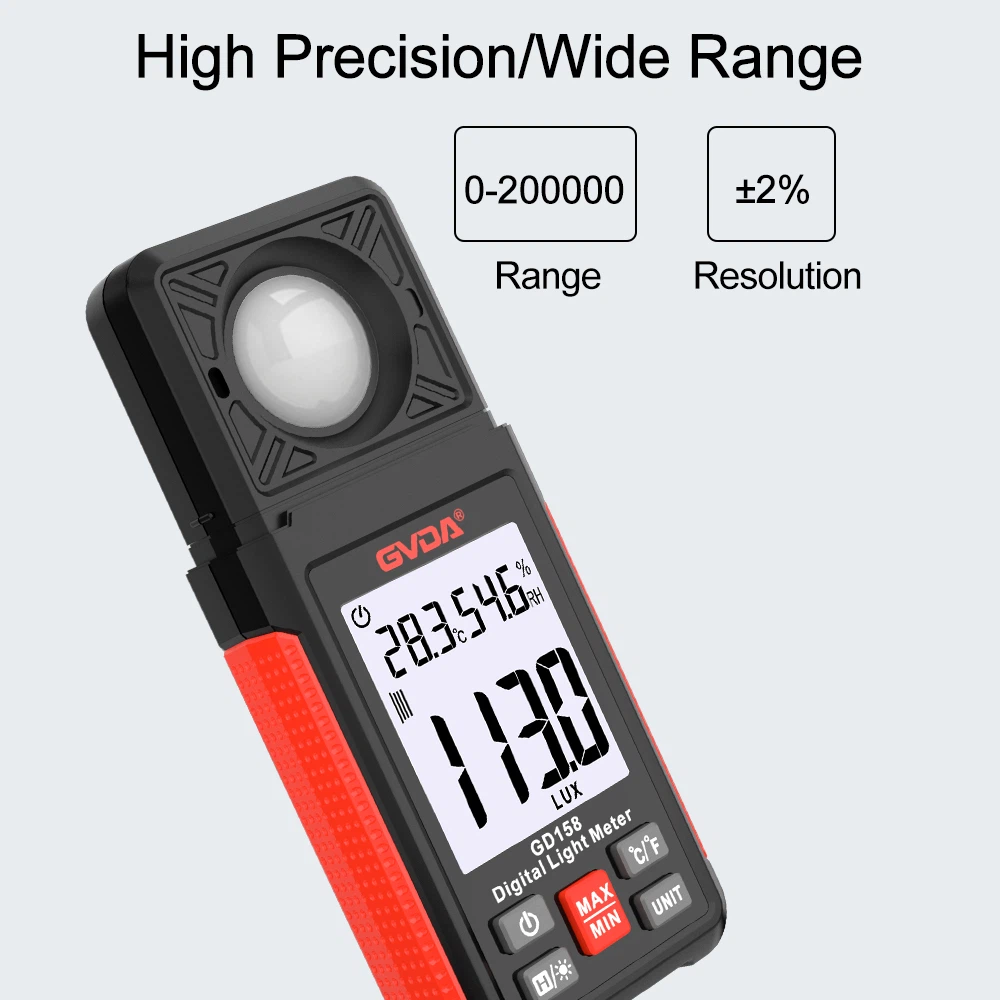
General requirements for light meters:
● Compact Size, Light Weight
Illuminance meters have a wide range of uses and are often used in different places. Therefore, a portable, small size and light weight are the prerequisites for an illuminance meter.
● Accuracy﹝Accuracy﹞
Whether a light meter is good or bad has a direct relationship with its accuracy. Of course, it is also closely related to its price. Therefore, it is necessary to buy a high-accuracy illuminance meter at a reasonable price. Generally, it is appropriate to have an error of no more than ±15%.
● Color Compensation﹝Color Compensation﹞
The types of light sources are all-encompassing. Some focus on red high-pressure lamps with longer wavelengths, or blue-violet lamps with shorter wavelengths such as Daylight fluorescent lamps. There are also evenly distributed ones such as incandescent light bulbs. The same illuminance meter may have slightly different sensitivity to different wavelengths. are different, so appropriate compensation is necessary.
●Cosine Compensation﹝Cosine Compensation﹞
As we all know, the brightness of the illuminated surface is related to the incident angle of the light source. In the same way, when measuring with a light meter, the incident angle of the sensor (Sensor) and the light source will naturally affect the reading value of the light meter. Therefore, whether a good illuminance meter has the function of cosine compensation cannot be ignored.
Calibration of light meter:
Let Ls illuminate the photocell vertically → E=I/r2. By changing r, the photocurrent values under different illumination can be obtained. The current scale is converted into the illumination scale based on the corresponding relationship between E and i.
Calibration method:
Use a light intensity standard lamp to change the distance l between the photovoltaic cell and the standard lamp at an approximate working distance of the point light source, record the readings of the ammeter at each distance, and calculate the illuminance E according to the inverse square distance law E=I/r2, as This can obtain a series of photocurrent values i with different illuminances, and draw the change curve of photocurrent i and illuminance E, which is the calibration curve of the illuminance meter. From this, the calibration curve of the illuminance meter can be calculated by dividing the dial of the illuminance meter.
Factors affecting the calibration curve:
Photocells and galvanometers need to be recalibrated when replaced; the illuminance meter should be recalibrated after being used for a period of time (generally it should be calibrated 1-2 times a year); high-precision illuminance meters can be calibrated with light intensity standard lamps; expand The calibration range of the illuminance meter can change the distance r, or different standard lamps can be used, and a small-range galvanometer can be used.