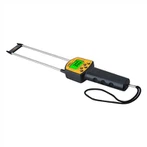
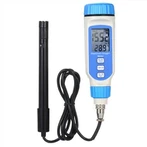
Good time to use needle moisture meter and needleless moisture meter
In many cases, it may be necessary to test the moisture content (%MC) of certain substances. And, when it comes to testing the moisture content of materials directly, there are two main options - needle-type water needle moisture meters and needle-less moisture meters
Pin moisture meters use the electrical resistance principle to measure the moisture content in various materials. Since water is a conductor and materials such as wood, cotton, plaster, and hay are resistors, the easier it is for electricity to flow through a material, the wetter it is. For accuracy, it is important to ensure that the needle meter is calibrated for the specific material being tested - as different materials have different inherent resistances to electrical current.
Pinless moisture meters, on the other hand, use electromagnetic radio frequencies to "scan" a material sample to determine the presence of water. Fluctuations in electromagnetic waves are used to measure the amount of water in a sample. The accuracy of a needleless moisture meter is affected by the specific gravity (SG) of the material being scanned, so the meter needs to be calibrated for the SG value of that material. Specific gravity is a measure of the relative density of a material compared to another material, usually water.
Both pin and pinless hygrometers have unique advantages and disadvantages that may make them more or less useful for specific humidity testing situations. When should you use a needle moisture meter and when should you use a needleless moisture meter? Here is a broad spectrum of situations in which one hygrometer may be better than another.
Choose: Needleless Moisture Meter
Testing for moisture in uneven surfaces and loose fill materials
Pinless moisture meters require full contact with a solid surface to provide accurate readings. The accuracy of the needleless moisture meter will be affected if the scanning plate does not lie completely flat on the material being measured. Additionally, if the material being scanned is loosely packed (such as for insulation or hay), the meter may end up testing the moisture content of the air between the fibers of the material.
Pin moisture meters, on the other hand, can easily be used to test materials that are loosely packed or have uneven surfaces. What matters is the current flow in the material being tested - as long as there is a path for the current to flow from one pin to another, the test is complete. However, to test moisture in fiberglass insulation, hay bales, etc., specialized electrodes may be required.
Choose: Pin Moisture Meter
Test moisture in materials you don't want damaged
Pinless moisture meters are sometimes called "non-invasive" or "non-destructive" moisture meters because they do not have to penetrate the surface of the material being measured to obtain an accurate moisture content measurement. That's why many flooring professionals use a pinless moisture meter to test the moisture content of their hardwood floors. With a needleless meter, moisture levels can be assessed without damaging your hardwood floors.
Pin moisture meters, on the other hand, need to penetrate the surface of the material for proper testing. In applications where the surface condition of the final product needs to be protected, leaving pinholes, even small pinholes that can easily be filled or filled with epoxy, is often less than desirable.