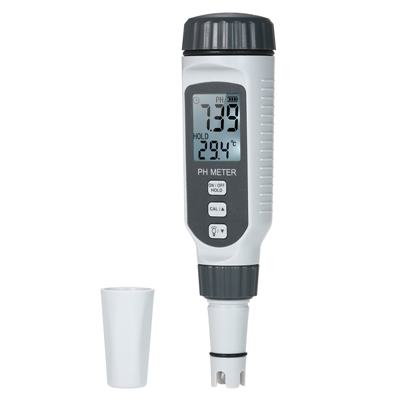
Hengaode's best-selling illuminance meter measurement principle using steps
①Turn on the power.
②Open the cover of the photodetector and place the photodetector horizontally at the measuring position.
③Select the appropriate measurement gear.
If only "1" is displayed at the left end of the display, it means that the illumination is too much, and you need to press the range key (⑧ key) to adjust the measurement multiple.
④The illuminance meter starts to work and displays the illuminance value on the display.
⑤ The data displayed on the display screen is constantly changing. When the displayed data is relatively stable, press the HOLD key to lock the data.
⑥Read and record the observed value displayed in the reader. The observed value is equal to the product of the number displayed on the readout and the span value.
For example: 500 is displayed on the screen, the status displayed in the lower right corner is "×2000", and the illuminance measurement value is 1000000lx, that is (500×2000).
⑦Press the lock switch again to cancel the reading lock function.
⑧ For each observation, take three consecutive readings and record them.
⑨ After each measurement is completed, press the power switch key to cut off the power.
⑩Close the photodetector cover and put it back into the box.
Measuring principle
Photovoltaic cells are photoelectric components that directly convert light energy into electrical energy. When the light hits the surface of the selenium photovoltaic cell, the incident light passes through the metal thin film 4 and reaches the interface between the semiconductor selenium layer 2 and the metal thin film 4, generating a photoelectric effect on the interface. The magnitude of the generated photocurrent has a certain proportional relationship with the illuminance on the light-receiving surface of the photocell. At this time, if an external circuit is connected, a current will flow, and the current value will be indicated on a microammeter with a scale of lux (Lx). The magnitude of the photocurrent depends on the intensity of the incident light. The illuminance meter has a shifting device, so it can measure high illuminance or low illuminance. Types of illuminance meters cited: 1. Visual illuminance meter: inconvenient to use, low accuracy, rarely used 2. Photoelectric illuminance meter: Selenium photocell illuminance meter and silicon photocell illuminance meter are commonly used
Illumination calibration
Calibration principle:
Let Ls irradiate the photocell vertically → E=I/r2, change r to get the photocurrent value under different illuminance, and convert the current scale into the illuminance scale according to the corresponding relationship between E and i.
Calibration method:
Using the light intensity standard lamp, under the working distance of the approximate point light source, change the distance l between the photocell and the standard lamp, record the readings of the ammeter at each distance, calculate the illuminance E by the inverse square law of distance E=I/r2, and calculate the illuminance E by This can get a series of photocurrent values i with different illuminance, and make the change curve of photocurrent i and illuminance E, which is the calibration curve of the illuminance meter. From this, the calibration of the illuminance meter can be done by dividing the dial of the illuminance meter.
Factors affecting the calibration curve:
The photocell and ammeter need to be re-calibrated when they are replaced; the illuminance meter should be re-calibrated after a period of use (generally 1-2 times within a year); the high-precision illuminance meter can be calibrated with a light intensity standard lamp; expand The calibration range of the illuminance meter can change the distance r, or choose different standard lamps, and choose a small-range galvanometer