How accurate does an infrared thermometer need to be to be used as a medical grade
Common contact measurement methods include mercury thermometers, household electronic thermometers, and medical temperature probes. The temperature of the human body is measured by contacting relevant parts of the human body, such as armpit and oral cavity. The accuracy of contact measurement is about 0.1 degrees. It can meet the requirements of rapid and accurate temperature measurement for clinical diagnosis.
However, due to the direct contact with the human body, the contact measurement may be infected by germs every time it is measured. It needs frequent disinfection, and the measurement speed is slow, so it cannot perform continuous and rapid measurement on a large number of human bodies. For example, mercury thermometers need to be placed under the armpit for 15 minutes, while household electronic thermometers and medical temperature probes also take 3 to 5 minutes to measure.
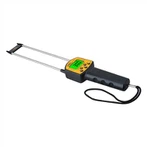
household electronic thermometer
The most typical method of non-contact measurement is infrared temperature measurement. Since the principle of infrared radiation was discovered, infrared technology has been widely used in temperature measurement. The infrared thermometer has the characteristics of wide temperature measurement range, fast response speed and high sensitivity. Infrared ear thermometers, infrared forehead thermometers and infrared screening instruments are all non-contact thermometers.
However, compared with contact temperature measurement, the accuracy of non-contact temperature measurement is lower. The high-precision non-contact thermometer is about 0.2 degrees, and the poor temperature measurement error is 1 degree or even more than 1 degree. The temperature measurement time is about 5 seconds, which is very fast, so it is widely used in daily temperature measurement and industrial temperature measurement.
The reason why the error of infrared temperature measurement is larger than that of contact temperature measurement is that infrared temperature measurement is easily affected by environmental factors such as atmospheric conditions, ambient temperature, and surface emissivity of the measured object. For example, water vapor and dust particles in the air have a strong absorption effect on infrared radiation; the radiant energy of the thermal radiation source near the target object interferes with the radiance of the target object; will have an impact. In addition, as the temperature measurement distance increases, the ability of the temperature measurement device to sense the radiation of the object will also be affected. Therefore, when the temperature of the measured object is constant, the temperature of the object sensed by the temperature measuring device is also different with the measurement distance, ambient temperature and other factors, thereby reducing its measurement accuracy.
Today's temperature measurement products such as handheld infrared thermometers on the market are easily affected by the measurement distance and ambient temperature, and the measurement error is often about 1 degree. Require.
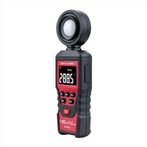
Handheld Infrared Thermometer
Three classifications of infrared thermometers
According to different purposes and accuracy, infrared thermometers can be roughly divided into medical grade infrared thermometers, consumer grade infrared thermometers and industrial grade infrared thermometers.
Strictly speaking, medical-grade infrared thermometers have the highest accuracy requirements, and the accuracy needs to be between 0.1 and 0.2 degrees. High-precision infrared ear thermometers can meet the standard of medical-grade temperature measurement, but in order to avoid cross-infection, hospitals use ear A disposable sheath needs to be added to the temperature gun; consumer grade is next, and the accuracy of about 0.5 can meet our daily temperature measurement needs, such as Baoma used to measure the temperature of bath water. At present, most of the handheld infrared thermometers on the market are priced between 100 yuan and 1000 yuan, and the accuracy is mostly about 0.3 degrees. They are consumer-grade infrared thermometers; the industrial grade is the lowest, and the maximum allowable error is generally ±1℃. above, and the distance is farther.