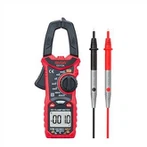
"How accurate is a multimeter measurement?
After measuring the chopped mains between Fluke 15B and 187, the voltage values are different. One is an entry-level multimeter and the other is a high-end multimeter. The difference is very large. Then I compared different multimeters and found that each one Not the same, but when measuring the sine wave, it will display 220V accurately; as a result, the great god of the forum told me that the algorithm is different, so I increased my knowledge.
Two days ago, I saw someone in the forum talking about the reliability of the multimeter. It happened that I also encountered this phenomenon in actual operation. I will give you another reference. The ideal multimeter has no effect on our products, but in practice it will inevitably be There is interference, and our actual measurement must be estimated accordingly to select the appropriate gear to avoid errors as much as possible. Moreover, our instruments must also be calibrated accordingly during use. Many devices such as power supplies have a large drift in accuracy, and must be calibrated with a multimeter such as a measuring device first.

Because it is not a programmable power supply, the price is cheap and the error is relatively large. When only one 3030 1W SMD LED is lit, the power supply shows 1.9V 0.1A, while the multimeter shows 2.023V, which is naturally subject to the multimeter.
However, after the current range of the multimeter is connected in series, there will be a big gap in the current value, but what is even more surprising is that the difference between the results measured by the mA range and the A range is almost double. Which is true?
After replacing the resistor, the difference is not so obvious. 2V/100mA estimates that the resistance of the LED is about 20R at this time; using a 10R porcelain plate resistor as the load will find that the difference between the mA gear and the A gear is about 30mA, but it is not As big a difference as the LEDs.
Why do LEDs make such a big difference? Is the multimeter malfunctioning? That's definitely not possible, because a brand new multimeter that has just been inspected has a very low probability of error. In fact, this is just a very simple measurement of DC voltage and current. Every measurement is correct, but which result is more reliable? Naturally, it should be the most credible resistance measurement in the A gear!
The reason why the measurement result is correct but not credible is because the introduction of the multimeter caused errors. The following picture is the circuit diagram of a multimeter, which seems to be 15B. The principle of each multimeter is similar. From the figure, we can see that the resistances connected in series between different current levels are different. In fact, the principle of the ammeter is to pass the current of the circuit through a constant resistance, and then measure the voltage across the resistance. The smaller the connected resistance, the smaller the impact on the circuit. It can be seen from the figure that the 10A gear is connected to 0.01R, and mA/uA will be connected to 9.99R/990R and other resistors respectively. Therefore, the above test results are the most credible.
Why do LEDs make such a big difference? If you have any doubts about this, then sorry, you must have understood the LED as a resistance. According to the V/A characteristic curve of the LED, we can see that the resistance of the LED is not a stable parameter, which can be approximated at a certain stage. It is regarded as a stable resistance, but the whole curve is close to a curve of the power of the dead. So the size of the series resistance will greatly affect the current measurement results of our LED. When using mA gear, due to the increase of the partial pressure of the detection resistor, the partial pressure of the LED decreases, the operating current will decrease sharply, and the difference in the measured results will be relatively large.
However, since many light-emitting LEDs are now dimmed by PWM, they often do not pay attention to the volt-ampere curve of the LED. However, this test also gives you a warning, that is, you should not be superstitious about the instrument, and you should pay attention to your own parameter design. , and review the specifications of the device more. There is a saying that the circuit is calculated, and the multimeter can only be used as an auxiliary reference. When you encounter differences in measurement and design, you must boldly verify, not blindly entangled in your own design problems, and ignore the errors introduced by the characteristics of the instrument.
"