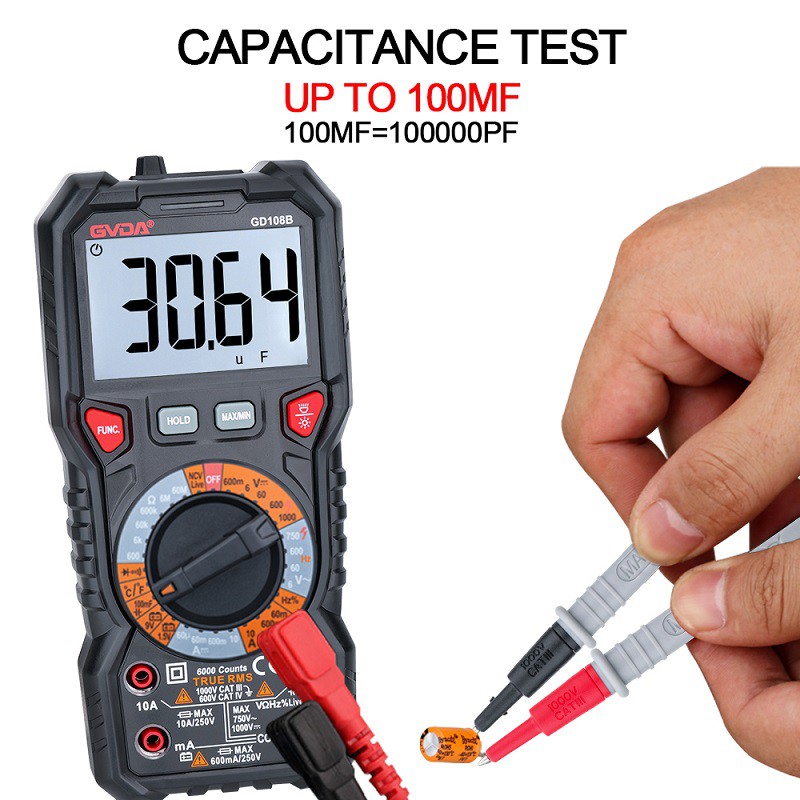
How can we check the electrolytic capacitors' condition using a multimeter?
How to check the electrolytic capacitors' condition with a multimeter
Step 1: Set the multimeter's appropriate gear for the ohm gear first. In general, the "20k" gear is used to identify capacitors with capacities below 1UF, while the "2"K gear is used to detect capacitors with capacities between 1UF and 100UF. Use "200" to verify capacitors having a capacity more than 100UF.
Step 2: Next, attach the multimeter's two test leads to the capacitor's positive and negative poles at both ends (the red test lead goes to the capacitor's positive pole and the black test lead to its negative pole). If the multimeter always reads 000, the capacitor has an internal short circuit; if it finally reads 1, there may be a short circuit between the electrodes inside the capacitor. If the displayed value gradually rises from 000, the overflow symbol 1 will be displayed at the end, indicating that the capacitor is normal.
The MF47 meter can be used to quickly and accurately assess the capacity and quality of capacitors with a typical capacity range of 0.47uF to 2200uF. particular technique:
Connect the black test lead to the capacitor's positive pole and the red test lead to its negative pole, fully discharge the capacitor, and then determine whether the capacitor has been subjected to the maximum number of swings before determining whether it has been damaged.
Note: The red pen is connected to the capacitor's negative pole, and the black pen is attached to its positive pole. The data could be wrong if the connection is made improperly. Every time the capacitance is calculated, it must be recharged.
In conclusion, if the needle doesn't move at all or moves very slightly, the capacitor is defective. If the needle moves back too slowly, the multimeter's gear may be malfunctioning or the capacitor may be leaking. If the needle slowly starts to rise after returning, the capacitor is either defective or has a small leak.
The majority of retail digital multimeters available today have low prices and can directly detect capacitances as little as 200uF. Use a digital meter for comparison if you are unsure about any specific capacitors. Additionally, capacitors of equal capacity can be compared to those of 1.5uF, 3.3uF, 6.8uF, and other sizes.