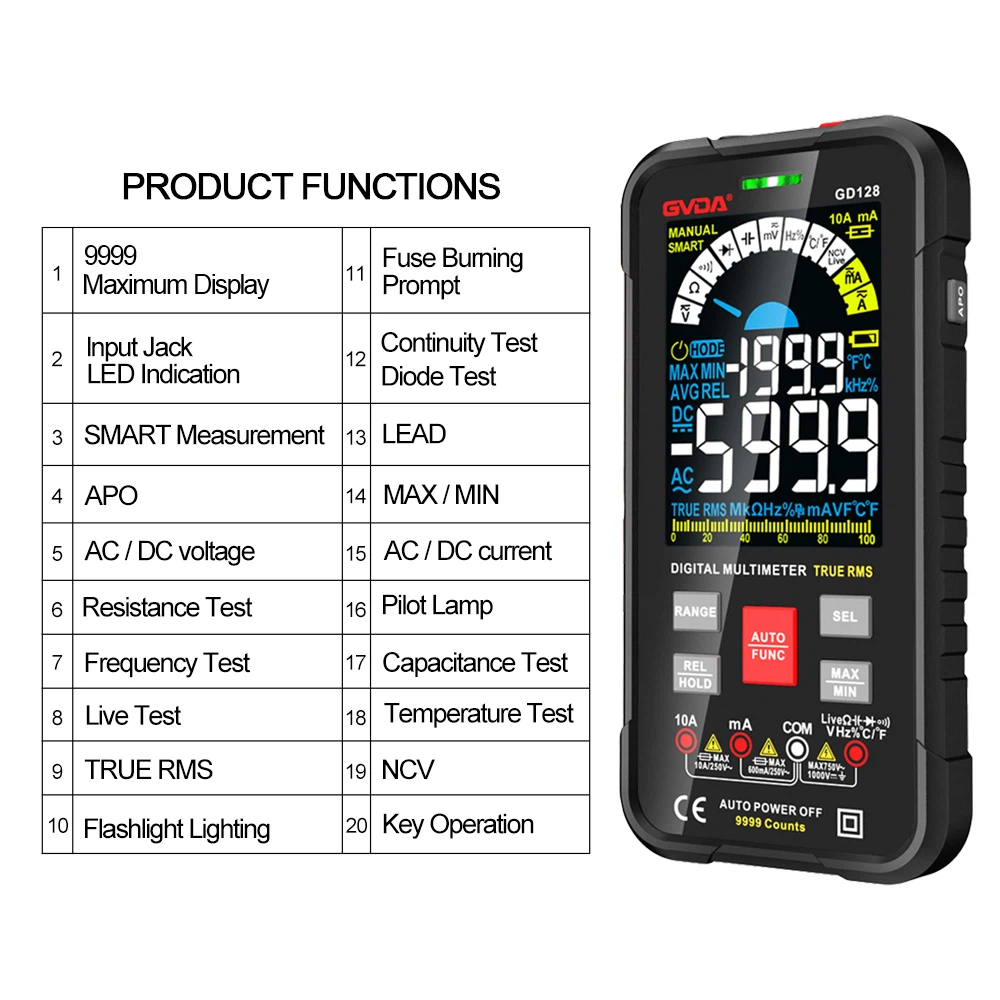
Talking about the difference between digital multimeter and pointer multimeter
1. Principle of multimeter
The working principle of the digital multimeter is: test parameters-analog-to-digital conversion-digital display; the working principle of the pointer multimeter is: test parameters-meter coil-electromagnetic induction-meter rotation display;
2. The structure of the multimeter
The internal structure of the pointer multimeter is simple, so the cost is lower, the function is less, the maintenance is simple, and the overcurrent and overvoltage ability is strong. The digital multimeter uses a variety of oscillation, amplification, frequency division protection and other circuits inside, so it has many functions. For example, it can measure current, voltage, capacitance, inductance, and make a signal generator. Due to the internal structure of digital multimeters, integrated circuits are often used, so the overload capacity is poor (but now some can automatically shift gears, automatic protection, etc., but the use is more complicated), and it is generally not easy to repair after damage.
3. Multimeter display mode
The digital multimeter adopts digital display, and the pointer multimeter adopts pointer scale display; the digital multimeter is intuitive, the display is accurate, and the digital display is easy to understand. The reading of an analog multimeter is relatively less straightforward than that of a digital multimeter. The pointer multimeter directly drives the hands of the analog current and voltage after rectification, shunting, and voltage division, and makes corresponding indications on the dial.
4. Multimeter reading result
The pointer multimeter is an average meter, which can directly display and stabilize when there is current or voltage. The digital multimeter is an instantaneous meter. It uses 0.3 seconds to take a sample to display the measurement results, sometimes the results of each sampling are very similar, not exactly the same, which is not as convenient as the pointer multimeter for reading the results.
5. The influence of the internal resistance of the multimeter
Different models of pointer multimeters have different internal resistances, and the measurement results are also different; while digital multimeters have a large internal resistance, and there is no distinction between models and instruments when measuring values.
6. The ability of the multimeter to interfere with the magnetic field
Most of the pointer multimeters are mechanical devices, and the anti-interference ability is mainly stronger than that of the digital multimeter. But in terms of shock resistance and drop resistance, analog multimeters are far inferior to digital multimeters. Since the digital multimeter is an electronic device, the electronic device will have inaccurate measurement in the case of magnetic field interference.
7. From the perspective of measurement accuracy
The internal resistance of the digital multimeter is high and there is no measurement error, so the accuracy of the digital multimeter is higher than that of the pointer multimeter. Digital multimeters can reach the millionth level; pointer multimeters cannot achieve such high precision.
8. Ease of use
All gears of the digital multimeter have an automatic zero adjustment function. When measuring the resistance of the pointer multimeter, it needs to be done manually every time (short the positive and negative poles, zero adjustment). When the digital multimeter is measuring resistance, after inserting the test leads as required, it only needs to adjust the gear.
9. In terms of measurement
Digital multimeters can be used to measure AC current, while pointer multimeters do not have this capability. The digital multimeter has a buzzer file, which can use the sound to prompt the connection of the line; the pointer multimeter needs to check the needle indication. If you use a multimeter, you need to check the pointer indication.
10. From the safety aspect of the multimeter itself
The digital multimeter has high accuracy, high precision, small error, and is easy to read. It is very good for misoperation and reduces damage caused by mistakes. For example, use a resistance file to measure voltage. The digital multimeter will alarm. The pointer multimeter will be damaged.
11. The digital multimeter must be powered on (usually with a 9 V stacked battery)
The pointer multimeter does not need battery power when measuring voltage and current. The battery in the meter is used as the power supply (usually 9V battery and 1.5V battery) when measuring passive components (such as resistance, capacitance, transistor, etc.).