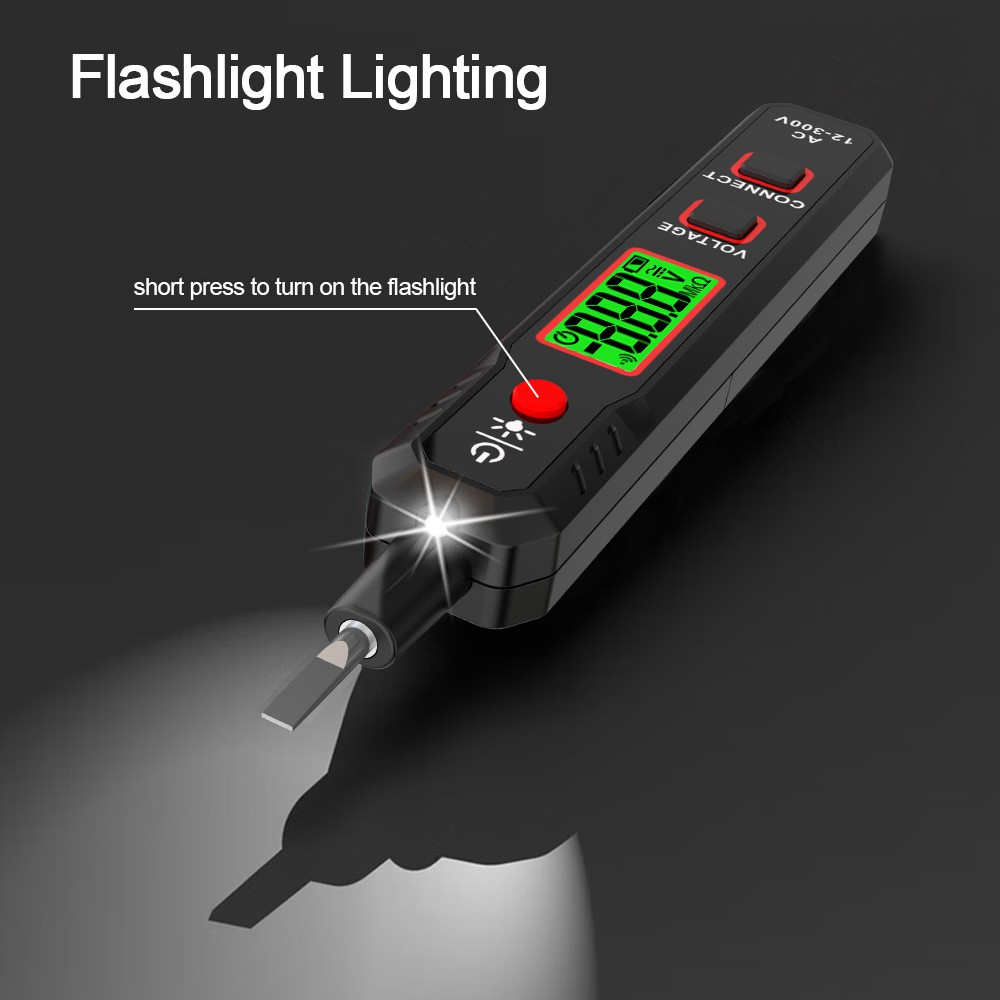
How many volts can be measured by an ordinary electric pen and its principle application
Working principle of electroscope pen
The low-voltage electroscope pen is the eyes of an electrician. It is a tool used to detect whether the wires, electrical appliances and electrical equipment are charged. When the current passes through the electrical appliance under test, the human body and the earth to form a loop, its leakage current makes the neon bulb glow and work.
The principle is that if the potential difference between the charged body and the earth exceeds a certain value, the neon bulb will emit light, and if it is lower than a certain value, it will not emit light, so as to judge whether the low-voltage electrical equipment is charged.
The voltage measurement range of ordinary low-voltage electroscope pens is 60--500v, and neon bulbs below 60v may not emit light. Voltages higher than 500v must be measured with electroscope pens of corresponding voltage levels to avoid electric shock accidents.
Test AC, DC and DC positive and negative poles
In addition to measuring whether the device is live, the electroscope pen can also test out AC, DC, and the positive and negative poles of DC. When using an electroscope to distinguish between AC and DC, it can be seen directly by visual inspection. The neon bulb of the electric test pen with direct current has only one head that glows. When testing alternating current, the middle of the neon bulb will glow.
When testing the positive and negative poles, connect the two ends of the electroscope pen between the positive and negative poles of the direct current. The luminous end (handhold) is the negative pole of the power supply, and the non-lit end (the metal pen tip of the electric pen) is the positive pole. Another method is to use the principle that direct current flows from the negative pole to the positive pole for testing. The power supply voltage is 110v and above. If a person is insulated from the earth, one hand touches any pole of the power supply, and the other hand holds an electroscope pen. The metal tip of the pen touches the other pole of the power supply under test. The opposite is the negative pole, and the opposite is the positive pole.
Use two electric pens to judge in-phase and out-of-phase
The way to judge whether the power supply is in phase or out of phase is to stand on an object that is absolutely insulated from the ground, hold an electric pen in each hand, and touch two charged wires at the same time. If they are in the same phase, the two electric pens will not emit light. If they are out of phase, the two electroscopes will emit light at the same time. This is because there is no potential difference between the same phases, but there is a potential difference between different phases to generate voltage, and the current will flow between the electroscope and the human body, but don't worry It will get an electric shock. Since the resistance value in the electroscope pen is very large, the current flowing through the human body is very small, so the human body will not get an electric shock, so feel free to use it.