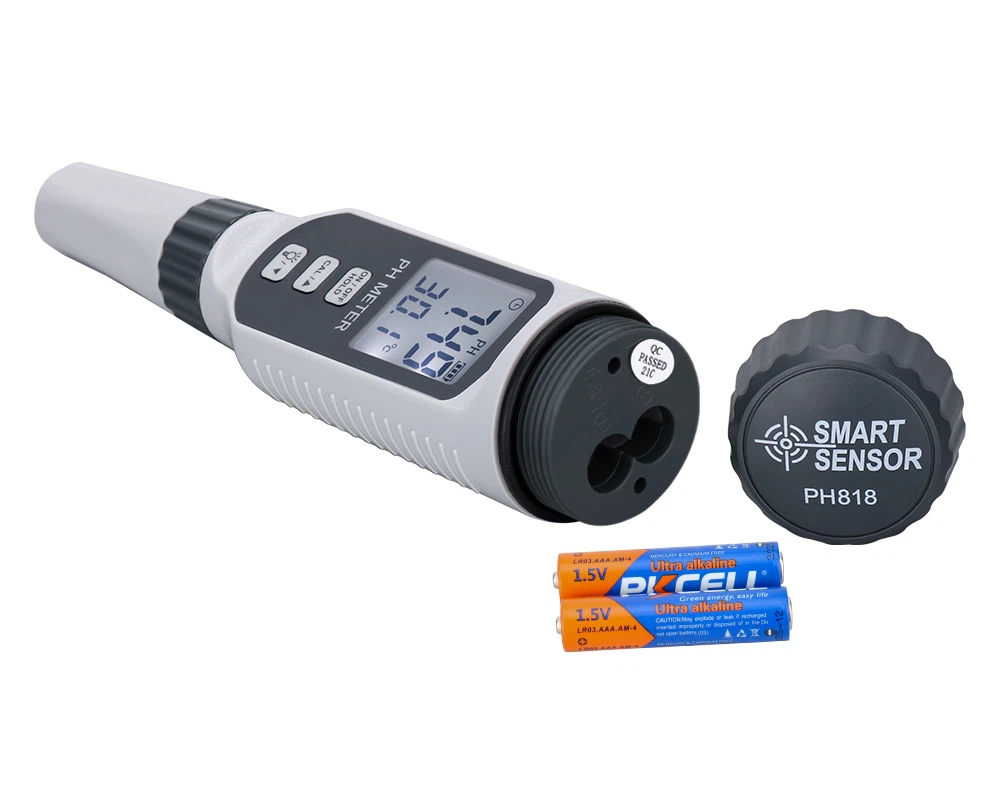
How to calibrate the ph instrument, ph instrument calibration steps
Single point calibration of pH meter
Any kind of acidity meter can only measure the pH value of a sample after being calibrated with a pH standard solution. For samples whose measurement accuracy is below 0.1pH, the instrument can be adjusted by a little accuracy method, and the standard buffer solution of pH 6.86 or pH 7.00 is generally selected. The accuracy of some instruments is only 0.2pH or 0.lpH, so the instrument is only equipped with a positioning adjustment knob.
The specific operation steps are as follows:
1. Measure the standard buffer temperature, check the table to determine the pHs value at this temperature, and adjust the temperature compensation knob to this temperature.
2. Rinse the electrode with pure water and shake it dry.
3. Immerse the electrode in the buffer solution, shake it, and then let it stand. After the reading is stable, adjust the positioning knob to make the instrument display the pH value of the standard solution.
4. Take out the electrode, clean and dry it.
5. Measure the temperature of the sample, and adjust the temperature compensation knob of the pH meter to the temperature value.
Two-point calibration of a pH meter
For precision acidity meters, in addition to positioning and temperature compensation adjustments, there are also electrode slope adjustments, so two standard buffer solutions need to be used for calibration. Generally, positioning (calibration) is performed at pH6.86 or pH7.00 first, and then according to the acid-base condition of the test solution, select pH4.00 (acidic) or pH9.18 and pHI0.0l (alkaline) buffer for slope correction. The specific operation steps are as follows:
1. Clean and dry the electrode, immerse it in the standard solution of pH6.86 or pH7.00, and set the temperature compensation knob of the instrument to the temperature of the solution. After the indicated value is stable, adjust the positioning knob so that the indicated value of the instrument is the pHs value of the standard solution.
2. Take out the electrode, clean it, spin it dry, and immerse it in the second standard solution. After the indicated value is stable, adjust the slope knob of the instrument so that the indicated value of the instrument is the pHs value of the second standard solution.
3. Take out the electrode, wash it, spin it dry, and then immerse it in the buffer solution of pH6.86 or pH7.00. If the error exceeds 0.02pH, repeat steps (1) and (2) until it can be displayed in both standard solutions Correct pHs without adjusting knobs.
4. Take out the electrode and spin it dry, adjust the pH temperature compensation knob to the temperature of the sample solution, immerse the electrode in the sample solution, shake it, let it stand, and display a stable reading.
Third point calibration of pH meter
No matter what kind of acidity meter it is, the point of pH=7 must be calibrated, and the point of pH=7 should be calibrated first, and then two-point calibration should be performed. When doing calibration, starting from 7.0, the selected standard solution is related to the pH value of the solution to be tested, so that the pH value of the solution can fall within the calibrated pH range. Generally, two points can meet the requirements. If the requirements are high, the third point will be considered. Some instruments can be calibrated at three points, and there are optional modes that can be used directly. Some don't. Generally, two-point proofreading is used, that is, proofreading twice.