How to choose between an inverted microscope and a fluorescence microscope?
In cell culture and related derivative experiments, the microscope is a very important instrument. At present, there are various types of microscopes on the market. It is a challenge to choose a microscope that meets the needs and is applicable. The following is an introduction to the principles of inverted microscopes and fluorescence microscopes, so that you can choose easily.
The composition of the inverted microscope is the same as that of the ordinary microscope, mainly including three parts: the mechanical part, the lighting part, and the optical part. The composition of the inverted microscope is the same as that of the ordinary upright microscope, except that the objective lens and the illumination system are reversed, the former is under the stage, and the latter is above the stage. Such a structure can significantly expand the effective distance between the illumination concentrating system and the stage, which is convenient for placing thicker objects to be observed, such as culture dishes and cell culture bottles (of course, glass slides, etc. are also available), and at the same time, the distance between the objective lens and the material The working distance between them does not have to be very large. Inverted microscopes are used for observation of microorganisms, cells, bacteria, tissue culture, suspensions, sediments, etc. in medical and health units, institutions of higher learning, and research institutes. It can continuously observe the process of reproduction and division of cells, bacteria, etc. in the culture medium, and can Take pictures of any form in the process. It is widely used in cytology, parasitology, oncology, immunology, genetic engineering, industrial microbiology, botany and other fields.
Fluorescence microscopy is used to study the absorption and transportation of substances in cells, the distribution and localization of chemical substances, etc. For the object under inspection, there are two ways to generate fluorescence: autofluorescence, which emits fluorescence directly after being irradiated with ultraviolet light; Some substances in the cells, such as chlorophyll, produce autofluorescence after being irradiated by ultraviolet rays; although some substances themselves cannot fluoresce, they can also emit secondary fluorescence after being stained with fluorescent dyes or fluorescent antibodies after being irradiated by ultraviolet rays. Fluorescence microscope uses a point light source with high luminous efficiency to emit light of a certain wavelength (ultraviolet light 365nm or purple blue light 420nm) through the filter system as excitation light, and after exciting the fluorescent substances in the specimen to emit fluorescence of various colors, then Observation is performed through the magnification of the objective lens and eyepiece. In this way, under a strong contrast background, even if the fluorescence is very weak, it is easy to identify and has high sensitivity. It is mainly used for the research of cell structure and function and chemical composition.
Fluorescence microscopes are divided into transmission type and epi-ejection type, the former is more primitive and the latter is more advanced. The basic structure of the two types of fluorescence microscopes is similar, the main difference is: the excitation light of the transmission type passes through the specimen, and the whole specimen generates fluorescence, which then enters the objective lens. The higher the magnification, the weaker the fluorescence; the excitation light of the epi-emission type is projected on the surface of the specimen , the surface of the specimen produces fluorescence, and the fluorescence enters the objective lens again. The higher the magnification, the stronger the fluorescence, which is suitable for high-magnification observation. The main components of the fluorescence microscope include a mercury lamp light source, an excitation filter plate, a dichroic mirror (episode type), a pressed filter plate, and a dark field condenser (transmission type), etc. In addition, due to the severe heat generation of mercury lamps, most of them are also equipped with heat-absorbing filters. Some fluorescence microscopes also have phase contrast objectives and annular diaphragms, so phase contrast observations are possible. There are also fluorescent microscopes that adopt an inverted structure, another inverted microscope, and so on.
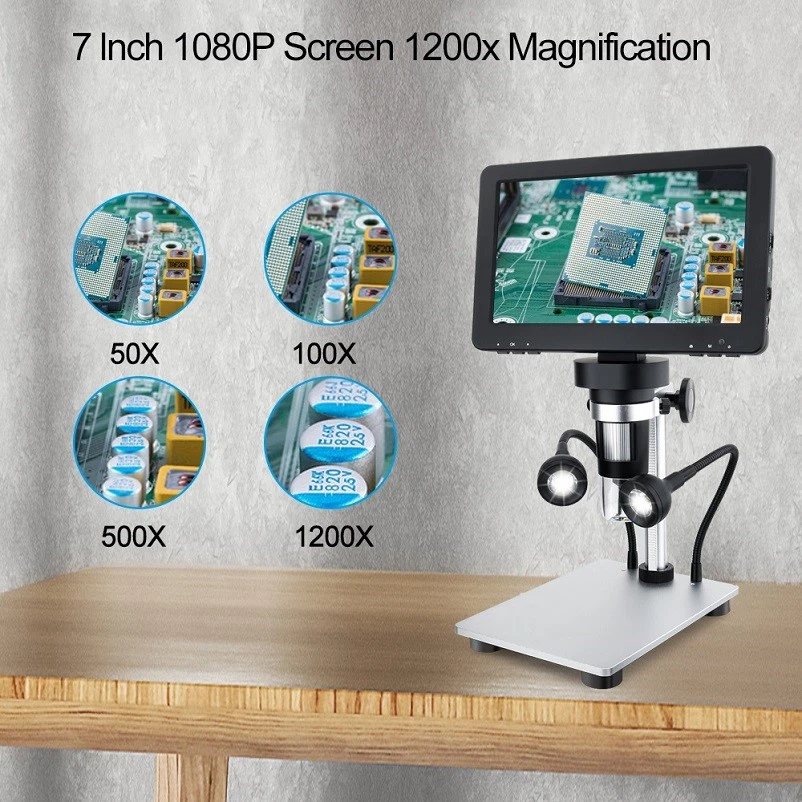
In addition, the above-mentioned microscopes can be assembled into a digital microscope by installing a CCD, which converts the physical image seen by the microscope into an image on a computer through digital-to-analog conversion. Therefore, we can change the research on the microscopic field from the traditional ordinary binocular observation to the reproduction on the display, thereby improving the work efficiency.