How to distinguish live wire and neutral wire in digital multimeter
When measuring DC voltage with a multimeter, it is easy to distinguish which wire is positive and which is negative. When measuring AC voltage, it can only read the voltage and cannot distinguish which wire is neutral or live.
In fact, as long as we understand the characteristics of a multimeter, we can easily determine the neutral wire:
The editor uses the MF47 pointer multimeter as an example. First, select the gear knob switch to the AC500V gear, and lightly press one finger on the black pen metal pin (the tighter the finger presses on the gauge pin, the higher the reading). The live wire has the highest reading, while the neutral wire has no reading. Sometimes there may be potential differences during measurement, with the highest reading being the live wire, followed by the neutral wire, and the lowest being the ground wire.
The second method is to wrap the black probe wire around the left hand 2-3 times, of course, the more turns the better the reading, the higher the reading. Those who are afraid can also touch the black pen on the ground or wall (the ground and wall are very dry and the reading is not significant).
Speaking of the principle of the electric pen, it consists of a front end metal, a carbon resistor, a neon bulb, and a rear end metal cap. The neon bulb is a device that emits light, and the carbon resistor has a resistance value of 1M ohms or more. The rear end metal cap is the part that the human hand touches. When a person comes into contact with the metal cap, the live wire, the electric pen, the human body, and the earth form a circuit, and the neon bulb emits light. There is a capacitance of about 100PF between humans and the earth, and the circuit is constructed in this way. The voltage range internal resistance of a pointer multimeter is approximately 20K ohms/V (the internal resistance of a digital multimeter is 10M ohms), and the circuit formed by the human body can be read to determine the neutral wire.
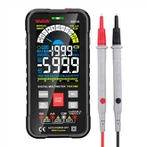
A multimeter is the most commonly used tool in electrical work. It can measure voltage, current, resistance, and continuity. Of course, it is also very simple to determine the neutral and live wires.