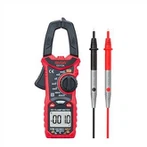
How to use a multimeter to detect capacitance?
Detection of fixed capacitors
(1) Detection of fixed capacitors with a capacity above 0.01 pF Set the pointer multimeter to R × Shift to 10k ohms and zero the ohms. Then use the red and black probes of the multimeter to contact the two pins of the capacitor, and observe the changes in the multimeter pointer, as shown in Figure 1. If the pointer of the multimeter swings slightly to the right at the moment when the probe is turned on, then returns to infinity, changes the probe, measures again, and the pointer also swings to the right and returns to infinity, then it can be determined that the capacitance is normal; If the pointer of the multimeter swings around "0" at the moment when the probe is turned on, it can be determined that the capacitor has been broken down or has serious leakage; If the pointer swings and no longer returns to infinity at the moment when the probe is turned on, it can be determined that the capacitor is leaking; If the multimeter pointer does not swing twice, it can be determined that the capacitor is open.
Detection of electrolytic capacitors
The capacity of electrolytic capacitors is much larger than that of general fixed capacitors. When measuring, appropriate ranges should be selected for different capacities. In general, the capacitance between 1-47 pF can be measured using R × 1k gear measurement; Capacitors greater than 47 ptF can be used with R × 100 gear measurement. The smaller the capacitance, the larger the resistance gear ratio should be selected. Before measurement, the capacitor should be fully discharged, that is, the two pins of the electrolytic capacitor should be short circuited to release the residual charge inside the capacitor. A multimeter probe can be used to short-circuit the two pins of the capacitor. The schematic diagram of the capacitor discharge method is shown in Figure 3. Large capacity capacitors require a screwdriver to discharge the metal part. After the capacitor is fully discharged, connect the red lead of the pointer multimeter to the negative electrode and the black lead to the positive electrode. At the moment when it is first connected, the multimeter pointer should deflect to the right by a large angle, then gradually return to the left until it stops at a certain position. The resistance value at this point is the forward insulation resistance of the electrolytic capacitor, which should generally be several hundred kiloohms or more. Exchange the probe for measurement, repeat the preceding phenomenon with the pointer, and the final indicated resistance value is the reverse insulation resistance of the capacitor, which should be slightly less than the forward insulation resistance.
In the above measurement, if the multimeter pointer does not move during measurement, it indicates that the capacitance has disappeared or there is an internal open circuit; If the positive and negative insulation resistance of the capacitor is very small or zero, it indicates that the capacitor has a high leakage current or an internal short circuit and cannot be used again. For electrolytic capacitors with unclear positive and negative markings, the method of measuring insulation resistance can be used to distinguish, that is, first use the two probes of a multimeter to contact the two pins of the capacitor and measure the insulation resistance of the capacitor. After replacing the probe, measure it again. The higher value is the positive insulation resistance, and at this time, the black probe is connected to the positive electrode of the capacitor.

(2) When detecting fixed capacitors with a capacity of less than 0.01 pF and detecting small capacitors below 10 pF, a multimeter is used for measurement due to its small capacity. Only if there is leakage, internal short circuit, or breakdown can be checked: a multimeter R is used for measurement × 10k gear, connect the two probes to any two pins of the capacitor, and the resistance value should be infinite. If the measured resistance value is zero, it can be determined that the capacitor has leakage damage or internal breakdown.
(3) Detect 10pF to 0.01; The following methods can be used to fix the TF capacitor. Set the multimeter to R × 10k gear, select two transistors 3DC6 (or 9013) with a voltage value greater than 100 to form a composite tube, and the circuit schematic is shown in Figure 2. By utilizing the amplification effect of the composite tube, the charging current of the measured capacitor is amplified to increase the oscillation amplitude of the multimeter pointer. Connect the measured capacitance between the base b and collector c of the composite tube, and connect the red and black probes of the multimeter to the emitter e and collector c of the composite tube, respectively. If the pointer of the multimeter swings slightly and returns to infinity, it indicates that the capacitance is normal; If the pointer does not move or cannot return to infinity, it indicates that the capacitor is damaged. During testing operations, especially when measuring small capacitance capacitors, it is necessary to repeatedly exchange the contact points between the tested capacitor pins to clearly see the oscillation of the multimeter pointer.