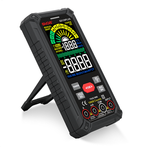
How to use a multimeter to detect short circuits in wires, and how to use the buzzer to detect short circuits and open circuits
I will give you a multimeter and let you use it to check whether there is a short circuit or open circuit in the line. Do you know how to operate it? Regarding the question of how to use a multimeter to detect short circuits in wires, here we focus on using the buzzer setting of the multimeter to detect short circuits and open circuits. Methods.
1. Multimeter to measure short circuit
Multimeters have a wide range of uses. They are used to measure whether there is a short circuit in a circuit. This is one of its common functions. When using a multimeter to detect short circuit problems, be sure to cut off the power first and then measure.
Measurement method: Set the function switch of the multimeter to the buzzer position, and place the two test leads on the two terminals to be tested. If there is a buzzing sound and the conduction voltage value is very small, it means a short circuit between the two points.
2. Multimeter to measure line insulation
Another way to use a multimeter to measure short circuit is to use a multimeter to measure the insulation function of the line to determine whether the line is short circuited.
Taking the measurement of single-phase ground insulation as an example, when the insulation value is zero (metallic grounding) or very low (non-metallic grounding), it means that this phase line is grounded. When not grounded, the insulation value is higher.
Then, use a multimeter to measure the phase-to-phase insulation. When the phase-to-phase insulation is zero, it means there is a short circuit between the two-phase lines.
3. Multimeter detects short circuit or open circuit
It is very convenient to use a multimeter to measure short circuit or open circuit.
First, make sure that the line is out of power, use the resistance setting (the pointer meter is in the RX10 setting, and the digital meter is sometimes called the on-off setting), and touch the two meter rods to the two points (or two lines) to be measured. If the pointer does not move, then It is an open circuit, and if the full scale is thrown over, it is a short circuit.