How to Use a Multimeter to Measure the Quality of an Inverter?
In the design process of electronic circuits, engineers inevitably need to use a multimeter to measure some measuring instruments. Engineers know that a multimeter can measure DC current, AC voltage, and DC voltage. An inverter is a device that controls an AC motor by modifying the frequency of the motor's working power supply. This article will explain to you how to use a multimeter to measure the quality of an inverter.
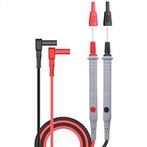
It should be noted that for personal safety, it is necessary to ensure that the machine is powered off and the input power lines R, S, T and the output lines U, V, W of the inverter are removed before operation! First, set the multimeter to the "diode" range, and then use the red and black test leads of the multimeter to detect according to the following steps:
Touch the negative pole P(+) of the DC bus with the black test lead, and touch R, S, T in turn with the red test lead, and record the values displayed on the multimeter. Then touch N(-) with the red test lead, and touch R, S, T in turn with the black test lead, and record the values displayed on the multimeter. If the six displayed values are basically balanced, it indicates that there is no problem with the diode rectifier or the soft-start resistor of the inverter. Otherwise, the rectifier module or the soft-start resistor at the corresponding position is damaged, and the phenomenon is no display.
Touch the negative pole P(+) of the DC bus with the red test lead, and touch U, V, W in turn with the black test lead, and record the values displayed on the multimeter. Then touch N(-) with the black test lead, and touch U, V, W in turn with the red test lead, and record the values displayed on the multimeter. If the six displayed values are basically balanced, it indicates that there is no problem with the IGBT inverter module of the inverter. Otherwise, the IGBT inverter module at the corresponding position is damaged, and the phenomenon is no output or a fault alarm.
Use the inverter to drive an asynchronous motor with a matched power rating on-site and let it run no-load. Adjust the frequency f, starting from 50Hz and decreasing it all the way to the lowest frequency.
During this process, use an ammeter to detect the no-load current of the motor. If the no-load current is very stable during the frequency decrease process and can remain basically unchanged, then it is a good inverter.
The lowest frequency can be calculated as follows: (synchronous speed - rated speed) × pole pairs p ÷ 60. For example, for a 4-pole motor with a rated speed of 1470 revolutions per minute, the lowest frequency = (1500 - 1470) × 2 ÷ 60 = 1Hz.