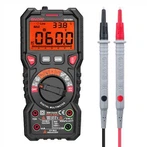
How to use and differentiate the thickness gauge?
Coating thickness gauge generally has the following five types according to the measurement principle:
1. Magnetic thickness measurement method: It is suitable for measuring the thickness of the non-magnetic layer on the magnetically conductive material. The magnetically conductive material is generally: steel, iron, silver, nickel. This method has high measurement accuracy, and the FT220 coating thickness gauge
2. Eddy current thickness measurement: It is suitable for measuring the thickness of non-conductive layers on conductive metals. This method has higher precision than magnetic thickness measurement. NT230 coating thickness gauge.
3. Ultrasonic thickness measurement method: At present, there is no such method in China to measure the thickness of the coating. Some foreign manufacturers have such instruments, which are suitable for the measurement of the thickness of multi-layer coatings or the occasions where the above two methods cannot be measured. However, it is generally expensive and the measurement accuracy is not high.
4. Electrolytic thickness measurement method: This method is different from the above three methods. It does not belong to non-destructive testing and needs to destroy the coating. Generally, the accuracy is not high. It is more troublesome to measure than other types
5. Radiation thickness measurement method: This kind of instrument is very expensive (generally above 100,000 RMB), and is suitable for some special occasions.
Currently, methods 1 and 2 are commonly used in China.
The principle of conventional coating thickness gauge
The covering layer formed to protect and decorate the material surface, such as coating, plating, cladding, sticking, chemically formed film, etc., is called coating in relevant national and international standards.
Cladding thickness measurement has become an important part of the processing industry and surface engineering quality inspection, and is an essential means for products to meet high quality standards. In order to make the products internationalized, there are clear requirements for the thickness of the cladding in my country's export commodities and foreign-related projects.
The measurement methods of coating thickness mainly include: wedge cutting method, optical section method, electrolysis method, thickness difference measurement method, weighing method, X-ray fluorescence method, β-ray backscattering method, capacitance method, magnetic measurement method and eddy current measurement law etc. Among these methods, the first five are destructive testing, the measurement methods are cumbersome and slow, and most of them are suitable for sampling inspection.
X-ray and β-ray methods are non-contact and non-destructive measurements, but the devices are complicated and expensive, and the measurement range is small. Due to the radioactive source, users must comply with radiation protection regulations. X-ray method can measure extremely thin coating, double coating and alloy coating. The β-ray method is suitable for the measurement of the coating and the coating with the atomic number of the substrate greater than 3. The capacitance method is only used when measuring the thickness of the insulating coating of a thin conductor.
With the increasing advancement of technology, especially after the introduction of microcomputer technology in recent years, thickness gauges using the magnetic method and eddy current method have taken a step forward in the direction of miniature, intelligent, multi-functional, high-precision, and practical. The measurement resolution has reached 0.1 microns, and the accuracy can reach 1%, which has been greatly improved. It has wide application range, wide measuring range, easy operation and low price, and is a thickness measuring instrument widely used in industry and scientific research.
The non-destructive method neither destroys the coating nor the substrate, and the detection speed is fast, so that a large amount of detection work can be carried out economically.
Application industry and classification of coating thickness gauge
The application industries of coating thickness gauges are distributed in electroplating, spraying; pipeline anticorrosion; aluminum profiles; steel structures; printed circuit boards, and screen printing, etc.
Electroplating and spraying: This industry uses our instruments a lot, accounting for a considerable proportion of annual sales, and they are our main user groups, which require continuous exploration.
Pipeline anticorrosion: there are many users mainly in petrochemical industry, generally the anticorrosion layer is relatively thick, and there are many users of LKTC-4 thickness gauge;
Aluminum profile: Affected by the country’s implementation of mandatory standards and the renewal of licenses by profile companies since the beginning of this year, the industry has shown a good momentum. It mainly measures the oxide film on the profile. "150 yuan is very considerable, so the state mandates that relevant testing equipment including coating thickness gauges be equipped. This move also brought us a very good opportunity. This opportunity has also attracted the attention of competitors, who lowered the price to a great extent, and quickly launched an offensive in this industry by means of distribution and other methods.
Steel structure: For our products, such enterprises can also be classified as an industry separately. Coating thickness gauges are indeed widely used in this industry, and manufacturers including iron towers have more recent purchase information;
Printed circuit board, and screen printing, etc.: Relatively speaking, this type of enterprises is a special industry, and the purchase volume currently only comes from a few sporadic manufacturers.
The detection principle of the coating thickness gauge
The principle of magnetic thickness measurement: when the probe is in contact with the coating, the probe and the magnetic metal substrate form a closed magnetic circuit. Due to the existence of the non-magnetic coating, the reluctance of the magnetic circuit changes. By measuring the change, the coating thickness can be calculated. thickness.
The principle of eddy current thickness measurement: use high-frequency alternating current to generate an electromagnetic field in the coil. When the probe is in contact with the covering layer, an eddy current is generated on the metal substrate and has a feedback effect on the coil in the probe. By measuring the size of the feedback effect The thickness of the covering layer can be exported.
According to the detection principle of the coating thickness gauge: it can be divided into magnetic coating thickness gauge, that is, the substrate to be measured is magnetic, such as steel, iron, etc., and there is also a non-magnetic coating thickness gauge as the name implies. , Also called eddy current thickness gauge, if the substrate is aluminum. There is also a dual-function coating thickness gauge, which means that whether its substrate is iron or aluminum, it can be automatically identified. Customers can choose according to their measurement needs.