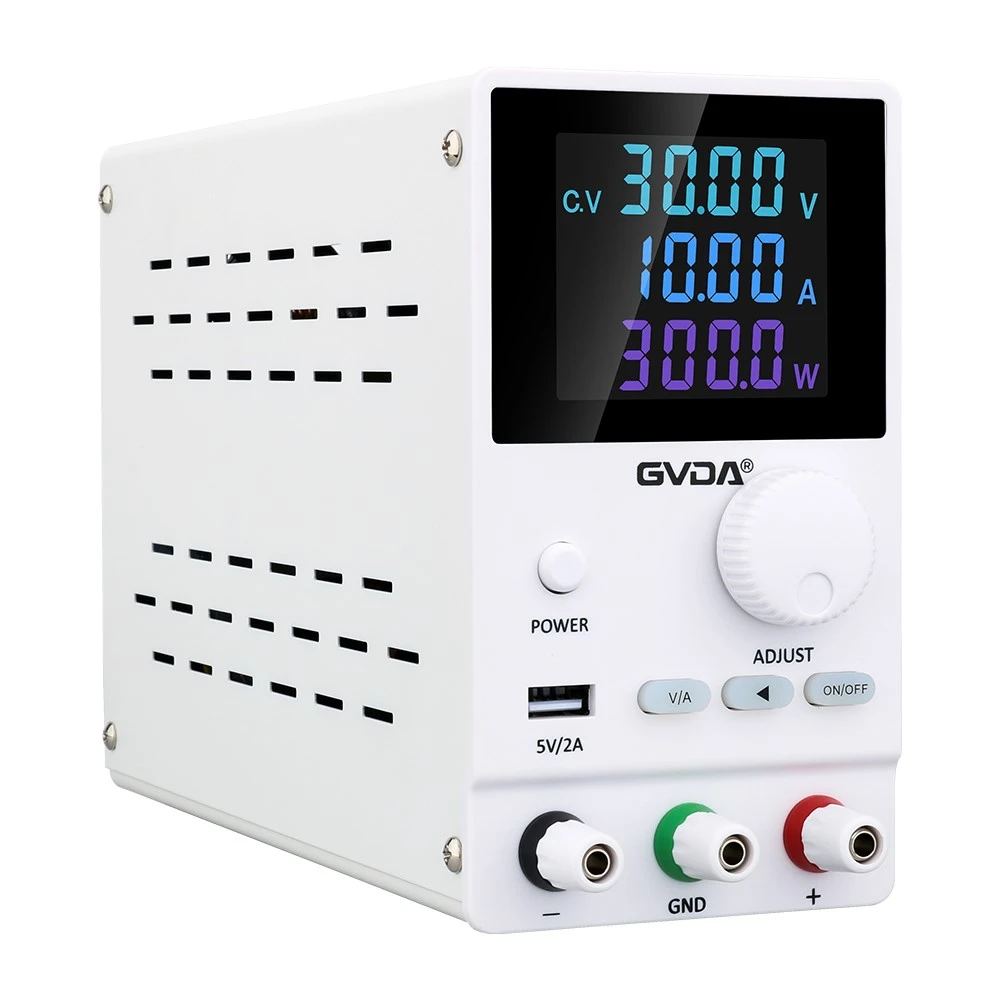
How to use programmable DC power supply
More and more different electrical appliances and instrumentation equipment have been produced, which has increased demands on power supply applications' adaptability. As a result, the market is calling for a universal electric power source that is affordable, versatile, and easy to use. The benefits of programmable DC power supplies—wide output range, high power, high current, low ripple noise, quick transient response, high resolution, high accuracy, and adjustable voltage and current slope—have led to their widespread use. So how can one operate a DC power source that is programmed?
The programmable DC power supply can be readily programmed to provide the desired voltage output waveform. Programming is able to set V1, V2, T1, T2dv, and dt among them. The maximum output current is 10A, and the output voltage range is 0~16V. There is a 0.1V accuracy in the output voltage and a 10mA accuracy in the current. The maximum current that may be output is indicated by the current setting value, which can also be programmed to have the same waveform as the output voltage.
In addition, the programmable DC power supply can also work in lead-acid battery charger mode (referred to as "LBC mode"). According to the characteristics of lead-acid batteries, when the program-controlled DC power supply works in LBC mode, the power supply will first output a larger charging voltage and current V1/I1 for at least 10 s; when the charging current drops to less than the set value I2, the program-controlled The DC power supply outputs a smaller charging voltage and current V2/I2. If the charging current has not dropped below I2 by the set time T1, the output of the program-controlled DC power supply will also drop to V2/I2. When the output current is greater than I2 again, the program-controlled DC power supply will output V1/I1 for charging again. Among them, the V2 setting value must be less than 14V. If set to greater than 14V, the power supply will automatically set it to 14V. The value of I2 must be greater than 1/8I1, otherwise it will be automatically set to 1/8I1 and LBC mode. Users can set the output of the programmable DC power supply in 3 ways:
(1) Programming through PC serial port. Program the program-controlled DC power supply by connecting the serial port RS232 of the PC to the serial port of the power supply, and then running the serial communication software on the PC.
(2) Mutual programming between programmable DC power supplies. Connect the serial ports of the two power supplies and operate the buttons on the panel of one of the programmable DC power supplies to program the other. The operating programmable DC power supply is called the "main power supply", and the programmed programmable DC power supply is called the "slave power supply". In this programming method, the parameters of the slave programmable DC power supply can only be set to be exactly the same as the main power supply, and each parameter cannot be set independently. A programmable DC power supply can only provide 100W of power. This method can be used in situations where larger power is required. Two or more program-controlled DC power supply outputs with the same settings can be connected in parallel to easily achieve power expansion.
(3) Program through the buttons on the programmable DC power supply panel. Set the output voltage, current limit value, time, etc. through the buttons.
Today I will share with you how to use the program-controlled DC power supply. The program-controlled DC power supply is controlled by a microcomputer, with advanced technology, full program control, and full button operation. It is small in size, light in weight, and easy to carry. It can be used in the laboratory or on site. use. Shenzhen program-controlled DC power supply is suitable for ATE system integration, laboratory testing, vehicle equipment testing, solar inverter testing, DC/DC converter testing, automotive electronics, engine starting testing, superconducting testing, motor testing, battery charging simulation, voltage/ The best choice for current sensor calibration, laser testing and power supply, electronic product life cycle testing and other applications.