How to use the pointer multimeter to calculate the voltage measurement value
A pointer multimeter generally has 4 to 5 scales, including resistance scale, voltage scale, current scale, decibel scale. In addition, there is a dedicated scale for AC 1OV, which reads directly in the 1OV range. The voltage range is further divided into AC and DC scales, and some meters also have AC current ranges. For example, the DC voltage range (MF-10 type meter) has 1V2.5V10 ∨ 50 ∨ 100V250V500V, and the DC voltage range scale has numbers from O to 5O. When the equivalent range switch is set to 50V, it reads directly. When the range switch is set to 1V, the indicated value is multiplied by 0.02 as the actual value, and when it is 10V, it is multiplied by 0.2100V. When multiplied by 2, the full scale is 1V, 10V, and 100V. When the equivalent range switch is set to 2.5V and 250, the actual values are obtained by multiplying the indicated values by 0.05 and 5, respectively. Set the equivalent range switch to 500 and multiply by 10. The same applies to the AC voltage range.
When you measure voltage, you will choose different gears to measure. When the pointer stabilizes at a certain value and no longer swings, multiply the value you read by the multiple of the gear you use to obtain the actual voltage value measured by the multimeter.
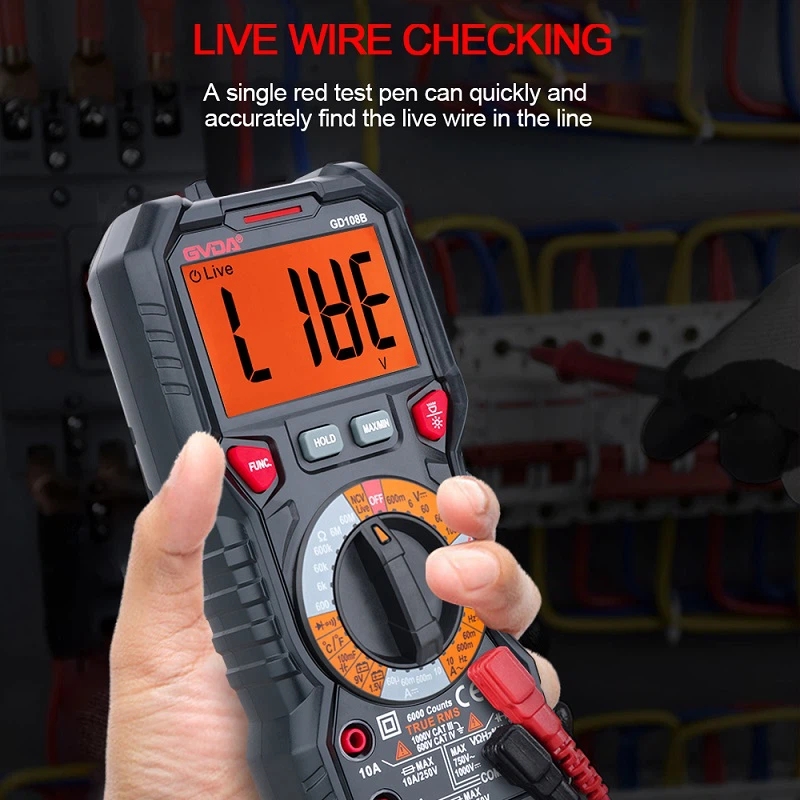
A multimeter can not only measure voltage but also measure leakage current. There are two methods for measuring leakage, one is the resistance method and the other is the voltage method. Regardless of the resistance method or the voltage method, the red probe is inserted into the V Ω hole of the multimeter, and the black probe is inserted into the COM hole of the multimeter.
How to use the resistance method to measure whether an electrical device is leaking electricity? First, turn off the power of the electrical device, use a multimeter, and adjust the multimeter's gear to the resistance's beep mode. One probe of the multimeter is placed on the outer shell of the electrical equipment, and the other probe is placed on the live and neutral wires respectively. If the multimeter makes a sound, it indicates that the electrical equipment has serious leakage and the location of the leakage must be checked.
If the multimeter does not make any noise, the resistance level of the multimeter should be raised step by step until the resistance value is measured. Generally, a resistance value below 0.38M ohms is considered leakage, and a resistance value above 0.38M ohms is considered non leakage.
The voltage method is used to measure electrical equipment leakage. Close the switch of the electrical equipment and turn the multimeter to the AC gear of 700V (the gear of each multimeter may be different, adjust it to the maximum current gear). The red probe of the multimeter is placed on the outer shell of the electrical equipment, and the black probe is placed on the neutral wire. The multimeter displays the voltage, indicating that the electrical equipment is leaking. The multimeter displays the voltage as zero, indicating that there is no leakage.
The voltage method has certain limitations in measuring leakage, as it can only measure the leakage of live wires and cannot measure the leakage of neutral wires. If there are capacitive components in electrical equipment, it will also affect the accuracy of voltage method measurement, so it is not recommended to use voltage method.