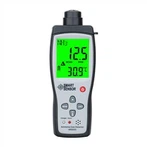
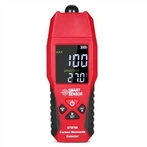
Improvement of the measurement accuracy of infrared thermometers
Characteristics of Infrared Thermometers
Infrared temperature measurement is a non-contact temperature measurement technology, which has the following characteristics: (1) non-contact measurement; (2) Fast response time, a few tenths of a second; (3) High sensitivity, with a temperature resolution of 0.1 ℃ and millimeter level spatial resolution; (4) The temperature measurement range is wide, from tens of degrees below zero to thousands of degrees. Due to the fact that there is no need to touch the object being measured during measurement, the temperature of difficult to touch objects can be accurately detected without contamination or damage to the object being measured. Portable red J'i, N thermometers are widely used in equipment fault diagnosis, HVAC, railway, petroleum, chemical, metallurgical, glass, metal processing and other fields due to their convenient portability and easy operation, which can be used for various target temperature detection. Starting from the basic principles of infrared temperature measurement, this article focuses on how to improve the accuracy of infrared thermometers.
Basic principles of infrared temperature measurement
Infrared is an invisible light that has a strong thermal effect. Any object in nature, as long as its temperature is above * * zero degrees (273~C), can emit infrared radiation. Using the infrared radiation of an object to measure the temperature of a substance is called infrared temperature measurement. The basic principle and basis followed by infrared temperature measurement is the Stefan Boltzmann law. This law provides the relationship between material temperature and radiation energy, where E is the radiation power of an object (W/m); Specific emissivity of a material; S-Stefan Boltzmann constant (5.67 X 10 W/(m · K)); Calculate the temperature (K) of the object. From the above formula, it can be seen that based on the radiation power emitted by the object (measured by the detector) and its specific emissivity (obtained from a table or experiment), its temperature can be calculated according to the above formula. How to improve the accuracy of infrared thermometers
3. Determine the temperature measurement range
The temperature measurement range is an important performance indicator. The coverage range of Raytek products is between 50 ℃ and 3000 ℃, but this cannot be achieved by a single model of infrared thermometer. Each model of thermometer has its own specific temperature measurement range. Therefore, users should have a general understanding of the temperature to be measured before deciding which model of thermometer to use. The temperature range to be measured must be considered accurately and comprehensively, neither too narrow nor too wide. The narrower the temperature measurement range of the thermometer, the higher the resolution and accuracy of the output signal for monitoring temperature, and the more accurate the temperature measurement. If the temperature measurement range is too wide, it will reduce the temperature measurement accuracy and result in significant errors.