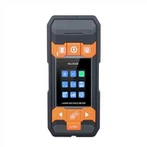
Infrared Night Vision Infrared Night Vision Imaging Technology
Visible light at night is very weak, but infrared rays invisible to the human eye are abundant. Infrared vision uses photoelectric conversion technology to help people observe, search, aim and drive vehicles at night. Although people discovered infrared rays very early, due to the limitation of infrared components, the development of infrared remote sensing technology is very slow. It was not until 1940 that Germany developed lead sulfide and several infrared transmission materials that the birth of infrared remote sensing instruments became possible. Since then, Germany has first developed several infrared detection instruments such as active infrared night vision devices, but none of them were actually used in World War II. There are two types of infrared vision instruments: active and passive: the former uses infrared searchlights to irradiate the target, and receives reflected infrared radiation to form an image; the latter does not emit infrared rays, but relies on the target's own infrared radiation to form a "thermal image", so it is also called "thermal image". Imager".
Infrared night vision imaging technology
Infrared night vision technology has experienced the early active infrared night vision imaging technology and the current passive infrared (thermal imaging) technology. The infrared detector was originally a unit detector, and later developed into a multi-element linear array detector in order to improve sensitivity and resolution, and has now developed into a multi-element area array infrared detector. Corresponding systems have made the leap from point detection to thermal imaging of targets.
(1) Active infrared image conversion technology (near infrared region).
This technology uses the principle of photoelectric image conversion to realize night observation. This type of instrument includes two parts: an infrared light source and a night vision goggle containing a variable image tube. The infrared light source illuminates the target, and the night vision goggles convert the invisible infrared image into a visible image. This type of technology began to be studied in the late 1930s, and was developed and applied in World War II. Rifle scopes equipped with active infrared night vision goggles are widely used in the Pacific theater. Around the 1960s, the technology became mature, and the observation distance could reach 3,000 meters. After that, it was widely equipped with troops, but because of its low sensitivity, large heat emission, high power consumption, large body, heavy weight, limited observation distance and easy exposure The Achilles' heel, therefore, was gradually replaced by night vision technology developed later, and now only a few countries have a small number of equipment.
(2) Passive infrared night vision technology (middle and far infrared regions)
Infrared thermal imaging camera is one of the most promising infrared detectors, representing the development direction of night vision equipment. It uses an internal photoelectric effect semiconductor device as a detector to convert the radiation image of the scene into a charge image, and after information processing, it is converted into a visible image by the display device. Some typical models include:
The ANS/pAS-13 "Thermal Weapon Sight (TWS)" developed by Raythe Systems of the United States for the U.S. Army is the most advanced passive infrared night vision device so far. It is a second-generation forward-looking infrared technology. Thermal imaging sighting system. The technologies used in this system include: high-sensitivity cadmium telluride focal plane technology for long-distance target acquisition in small telescopes; lightweight, high-transmission binary optics in advanced plastic housings; small size, low power consumption Very large scale integration (VLSI) electronic components; silent operation, high reliability, thumb-sized thermoelectric cooler; low power consumption, high light-emitting diode (LED) display; suitable for
1. Win the effective night battle time
Night and bad weather account for a considerable proportion of the year, and night vision equipment makes the night transparent, greatly extending the effective combat time. Infrared night vision equipment has a high resolution and has the advantage of detecting sea-skimming flying targets. The thermal imaging camera for shipboard tracking can be used not only to provide target data for launching missiles, but also to detect enemy sea-skimming missiles. The photoelectric fire control system, including thermal imaging equipment, facilitates target identification and shortens the reaction time of the weapon system.
2. Established the military status of night warfare
With the large number of night vision equipment equipped in the armed forces, Western developed countries have taken domination of night operations as a winning strategy.
3. Double the effectiveness of weapons
The combination of night vision technology and weapons and equipment will greatly improve the effectiveness of weapons and equipment in obtaining information, carrying out strikes, commanding troops, maneuvering forces and coordinating operations at night and in bad weather.
4. Reduce flight accidents
Aviation accidents can be greatly reduced by using navigation pods with forward-looking infrared cameras on aircraft and by having pilots wear goggles with night-vision goggles.