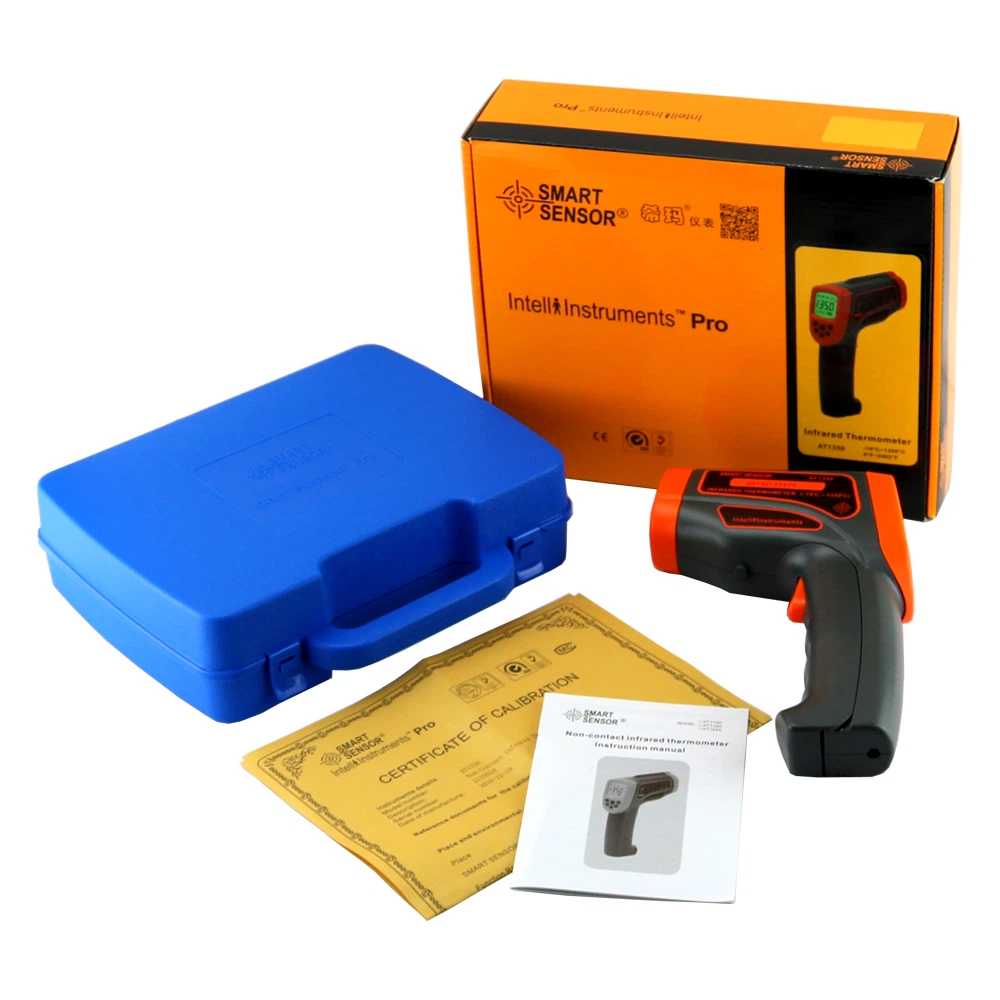
Infrared thermometers determine distance factor (optical resolution)
The distance coefficient is determined by the ratio of D:S, that is, the ratio of the distance D between the probe of the thermometer to the target and the diameter of the target being measured. If the thermometer must be installed far away from the target due to environmental conditions, and small targets are to be measured, a thermometer with high optical resolution should be selected. The higher the optical resolution, that is, the larger the D:S ratio, the higher the cost of the thermometer. The Raytek Infrared Thermometer D:S ranges from 2:1 (low distance factor) to above 300:1 (high distance factor). If the thermometer is far from the target, and the target is small, a thermometer with a high distance factor should be selected. For a thermometer with a fixed focal length, the light spot is the smallest position at the focus of the optical system, and the light spot will increase near and far from the focus position. There are two distance coefficients. Therefore, in order to accurately measure temperature at distances close to and far from the focus, the size of the target to be measured should be larger than the size of the spot at the focus. The zoom thermometer has a minimum focus position, which can be adjusted according to the distance to the target. Increasing D: S will reduce the received energy. If the receiving aperture is not increased, it is difficult to increase the distance coefficient D: S, which will increase the cost of the instrument.