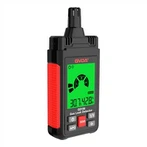
Installation Notes for Toxic‑Harmful Gas Detectors
Once a fixed toxic‑gas alarm is installed in position, its location is difficult to modify. The following points shall be considered for practical application:
① Identify potential leakage points of the equipment to be monitored, analyze factors such as leakage pressure and discharge direction, draw a probe‑location distribution diagram, and classify leakage severity into Grade Ⅰ, Grade Ⅱ and Grade Ⅲ.
② Determine the drifting direction of toxic gas in case of massive leakage based on on‑site air flow and wind direction.
③ According to the density of leaked gas (heavier or lighter than air) combined with air‑flow patterns, develop a three‑dimensional gas‑dispersion trend chart, and formulate an initial layout plan for detector points at downstream positions of gas flow.
④ Study the leakage pattern at each leakage point: slow seepage or jet‑type discharge. For slow seepage, install detectors closer to the leakage source. For jet‑type leakage, place detectors at a moderate distance away. Work out the final layout plan by integrating above conditions, so that the required quantity and model of detectors can be estimated.
⑤ For sites with high‑risk toxic‑gas leakage, arrange one detection point every 10‑20 meters in accordance with relevant regulations. For unattended small pump houses with intermittent operation, pay attention to potential toxic‑gas leakage; generally install one detector at the down‑wind side.
⑥ For sites with hydrogen‑leakage risk, mount detectors on the plane above leakage points.
⑦ For gases heavier than air, install detectors on the plane below leakage points and take surrounding‑site features into account. Pay special attention to setting key monitoring points in areas prone to toxic‑gas accumulation.
⑧ For open‑air sites with diffused toxic‑gas emission and poor ventilation, toxic‑gas concentration in local air may approach or reach the lower explosive limit. These locations constitute critical monitoring points that cannot be neglected.
Statistics from on‑site accident analysis show that more than half of failures are caused by improper installation and calibration. Therefore, it is necessary to specify precautions for correct installation and calibration to reduce malfunctions.