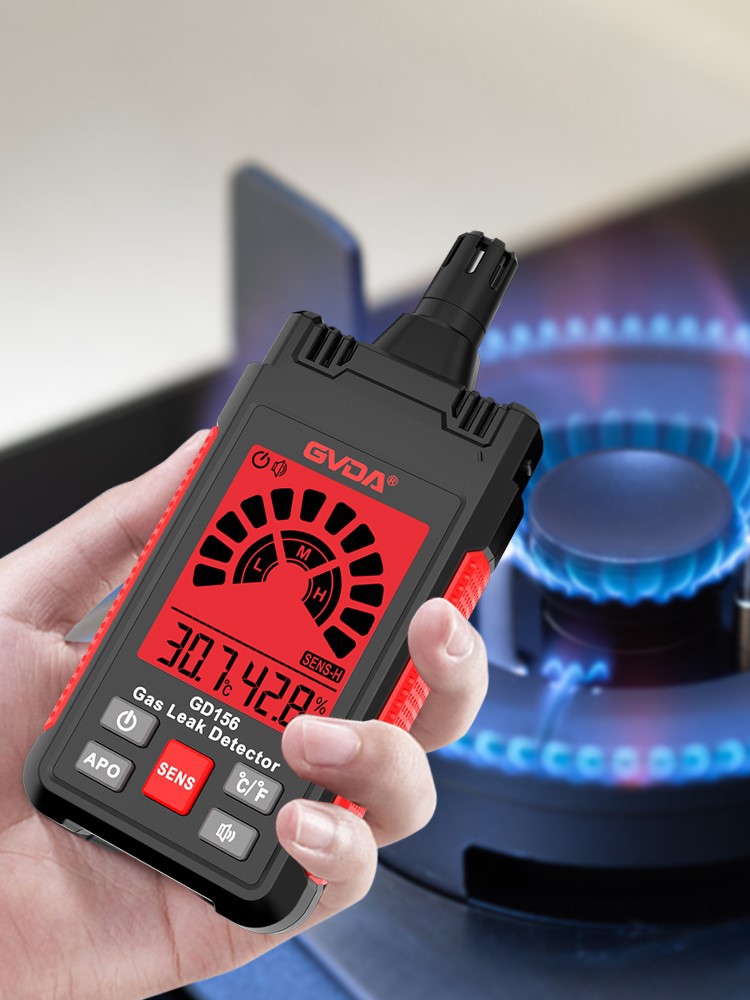
Introduction to commonly used sensors for gas detectors
The core part of a gas detector is a gas sensor, which varies according to different gas detection principles. Common gas sensors include PID photo ion sensors, infrared sensors, electrochemical sensors, catalytic combustion sensors, and semiconductor sensors.
1、 The Infrared Principle of Gas Detectors
Principle: Non spectral infrared principle: NDIR sensors use the Beer Lambert infrared absorption law, which means that different gases absorb specific wavelengths of light, and the intensity of absorption is directly proportional to the concentration of the gas to achieve detection. It is the application of filters to divide infrared light into a small band of spectral lines required, and the detected gas absorbs this small band of spectral lines.
Advantages: High reliability, good selectivity, high accuracy, no toxicity, less interference from the environment, long lifespan, and no dependence on oxygen.
Disadvantages: Due to the significant impact of humidity, the types of gas detected are limited. Currently, they are mainly used in gases such as methane, carbon dioxide, carbon monoxide, sulfur hexafluoride, sulfur dioxide, and hydrocarbons.
2、 Semiconductor Principles of Gas Detectors
Principle: Semiconductor gas sensors are manufactured using the principle that the resistance of some metal oxide semiconductor materials varies with the composition of the environmental gas at a certain temperature. For example, an alcohol sensor is prepared using the principle that when tin dioxide encounters alcohol gas at high temperatures, the resistance will sharply decrease.
Advantages: It has the advantages of low cost, simple manufacturing, high sensitivity, fast response speed, long service life, low humidity sensitivity, and simple circuit.
Disadvantages: Poor stability, significant environmental impact, especially the selectivity of each sensor is not unique, and the output parameters cannot be determined. Therefore, it is not suitable for use in places with accurate measurement requirements, mainly for civilian use.
3、 Catalytic combustion principle of gas detectors
Principle: A catalytic combustion sensor is a high-temperature resistant catalyst layer prepared on the surface of a platinum resistor. At a certain temperature, combustible gases catalyze combustion on its surface, causing the platinum resistor to rise in temperature and change in resistance. The change in resistance is a function of the concentration of combustible gases.
Advantages: Catalytic combustion gas sensors selectively detect combustible gases: Whatever cannot be burned, the sensor has no response. Fast response, longer lifespan, and less affected by temperature, humidity, and pressure. The output of sensors is directly related to the explosion hazard of the environment, and they are a dominant type of sensor in the field of safety detection.
Disadvantage: Within the range of combustible gases, there is no selectivity. Sensors are prone to poisoning, and most elemental organic vapors have toxic effects on sensors.
4、 PID principle of gas detector
Principle: PID is composed of a UV lamp light source and an ion chamber, which have positive and negative electrodes to form an electric field. Under the irradiation of the UV lamp, the gas to be tested ionizes to generate positive and negative ions, forming a current between the electrodes, and amplifying the output signal
Advantages: High sensitivity, no poisoning issues.
Disadvantages: No selectivity, greatly affected by humidity, short lifespan of UV lamps, and high price.