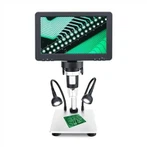
Introduction to the classification of microscope stages
1. The constant temperature stage is suitable for most inverted microscopes and wide observation stereomicroscopes. It can be automatically heated by a light source (or heated around). As the heating power supply is a DC power supply, it is not affected by mechanical vibration, electromagnetic interference, and magnetic fields. Both covered culture dishes and glass slides can be heated on the working surface.
2. Electric loading platform
The stage is a semi high type, equipped with precision components and encoder options, which can meet any positioning requirements. The high-speed and high-precision performance of the stage meets the requirements of high-resolution linear encoders.
3. Mechanical stage
The X and Y axes of the ball guide rail can move continuously, and it is compatible with stereo microscopes and digital (TV) microscopes for easy movement and positioning of small workpieces, completely solving the problem of shaking at high magnification!
2, Classification of stages by operation type:
1. Left hand loading platform
2. Right hand stage
In China, right-handed loading platforms are generally used. If a left-handed loading platform is needed, customization is required
3, The loading platform is classified by shape:
1. Square stage
2. Large desktop loading platform
3. Circular stage
Microscopic lens tilt and stage rotation
The fast and reliable workflow for inspecting printed circuit boards often requires viewing their complex 3D components from different angles, such as amplifiers, regulators, transistors, diodes, capacitors, and various other components. The Leica DVM6 digital microscope is equipped with a tilted main mirror device (-60 ° to+60 °) and a rotating sample stage (-180 ° and+180 °).
The following are examples of printed circuit board images recorded from different observation angles. When inspecting components, different observation angles are very important; For example, the voltage regulator welding wire shown in the red circle. Changing the observation angle can reveal different parts of the wires and components, which are "hidden" (tilted at 0 °) in the top view with a fixed angle.