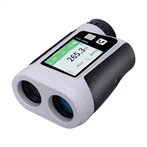
Introduction to the composition and structure of ultrasonic rangefinder
The ultrasonic rangefinder consists of an ultrasonic generating circuit, an ultrasonic receiving and amplifying circuit, and a counting and display circuit.
The ultrasonic generating circuit is an ultrasonic generating circuit. The dual timer EN556 (U2b) forms a monostable trigger. R6 and C6 form a differential circuit, whose function is to: when the button S2 is pressed, the low level becomes a positive and negative spike pulse, which passes through VD1 to obtain a negative spike pulse, triggering a monostable flip flop. The high level of monostable flip output lasts for about 1 ms, i.e. tw ≈ 1.1R5C5 ≈ 1 ms. EN556 (U2n) forms a multi harmonic oscillator, Ground resistance tester oscillation frequency f1=1/T1 ≈ 1/{0.7 [(R1+R2)+2 (R3+R4)] C3 ≈ 40 kHz. The oscillation of the oscillator is controlled by the output level of a monostable trigger. When the monostable trigger outputs high voltage, the multi harmonic oscillator generates oscillation, and pin 5 of EN556 outputs about 40 rectangular pulses with a frequency of 40 kHz and a duty cycle of about 50%. Considering the instability of the starting stage of the multi harmonic oscillator, the design has a large number of output pulses. If the number of output pulses is too small, the emission intensity is low and the measurement distance is short. However, due to the excessive number of pulses and the long duration of transmission, the pulse train has not yet been emitted when it is close to the measured object. This results in the echo generated by the first emitted pulse reaching the receiving end, affecting the ranging results and increasing the blind spot for ranging. The U1a~U1e of (U1) form an ultrasonic pulse driving circuit, which can increase the amplitude of the pulse voltage driving the ultrasonic sending sensor, effectively perform electrical/acoustic conversion, enhance the ability to emit ultrasonic waves, and increase the measurement distance. One path of the 40 kHz pulse train is inverted through U1a, and then inverted through a parallel inverter U1b and U1e; The other way is through the inverted phase of the parallel inverters U1c and U1d in the south.