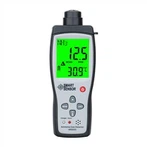
Introduction to the use of clamp watches
Purpose 1: Measure three-phase three-wire circuit current and three-phase four-wire zero line current
A clamp meter usually measures the current of a single wire. If two wires are clamped in simultaneously when measuring the current of a three-phase three-wire load, the indicated current value should be the current of the third wire.
The method of measuring the zero line current of a three-phase four wire circuit is the same as measuring the current of a three-phase three wire circuit. At the same time, clamp in three phase lines, and the indicated current value is the zero line current value.
Usage 2: Clamp meter for measuring small currents
The clamp meter measures small current, and even if the gear is adjusted to the smallest gear, the reading is still not very accurate. Therefore, the wire can be wrapped around the clamp arm to read the current value. Then divide the current reading by the number of turns to obtain the actual small current value.
Purpose 3: Determine the name of the current in the circuit
To judge whether the equipment is in normal operation, it needs to be determined according to the current measured on site, so it is important to determine what current is.
Purpose 4: Measure the no-load current of nameless motors to determine the rated power
Calculation formula: divide no-load current by zero point eight, and calculate power close to grade.
The steps are as follows: Measure the no-load current value I of the motor, and according to the empirical formula: p=I/0.8
Usage 5: Measure the no-load current of a 380V welding machine without a nameplate to determine the apparent power S
Estimation formula: The capacity of a 38th welding machine is equal to the no-load current I multiplied by 5.
The steps are as follows: Measure the no-load current value I of the welding machine, and according to the empirical formula: p=5I