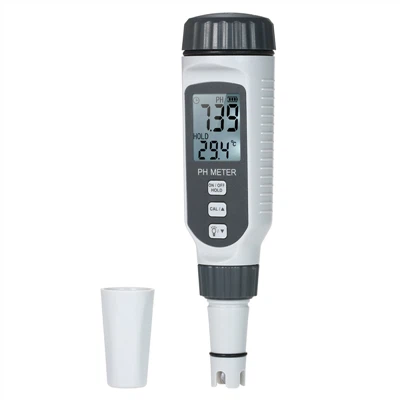
Inventory of pH meter measurement problems
1. pH measurement at high temperature
The high temperature of the aqueous solution generally refers to above 60°C. Under this condition, the solution has a particularly serious corrosion effect on the glass electrode, especially in the alkaline pH range. This corrosion effect causes the potential drift of the glass electrode and deteriorates its performance. .
In microbial breeding tanks in pharmaceutical, fermentation, food and other industries, pH measurement requires that the glass electrode can withstand high temperature stimulation at 120-130°C, that is, the electrode is required to withstand the erosion of high temperature solution.
the
Another problem that needs to be solved in high temperature measurement is the stability of the reference electrode.
In order to prevent the dissolution of AgCl at high temperature, thicken the AgCl layer, add solid AgCl to the electrode solution or use AgCl single crystal as the reference electrode; the reference electrode can also be connected outside the high temperature area and connected through a salt bridge.
2. pH measurement at low temperature
At low temperature, the internal resistance of the glass electrode rises sharply, so a low internal resistance pH glass electrode should be selected, and an organic solvent is added to the electrode internal solution to lower the freezing point.
3. pH measurement of non-aqueous solutions
Non-aqueous solutions refer to solutions composed of non-aqueous solvents, including pure non-aqueous solutions and partial non-aqueous solutions.
Many electrolytes, soluble in organic solvents, also require pH measurement. Commonly used organic solvents include ethanol, glycols, ethers, amides, nitriles, ketones, etc. Their ability to dissolve electrolytes is related to their dielectric constant ε. Their dielectric constant is significantly different from that of water (water ε=78.3), and may be higher or lower than water. For example, the dielectric constants ε of propanol, ethanol, methanol, glycerol, propylene glycol, and formamide are 20.7, 24.3, 32.6, 36.7, 42.5, and 109.5, respectively. Since the dielectric constant of organic solvents is different from that of water, the pH range and neutral point of each solvent are significantly different from those of water.
With the development of industry and the progress of science and technology, the research on the measurement of pH value of non-aqueous solution has been gradually carried out. The more mature ones are heavy water, propanol, ethanol, methanol, glycerol, propylene glycol, and formamide.
Pure water is chemically neutral, and the ion product constant Kw of water is equal to 10 to the -14th power at 250C. The magnitude of the "usual pH range" for aqueous solutions is usually defined as:
-logKw=14 Therefore, the pH measurement range is from 0 to 14.
The neutral point pHn of an aqueous solution is the pH value at which the concentrations of H+ and OH- are equal. pHn=-1/2logKw
pHn is related to temperature, at 250C, pHn=,7.00, at 1000C, pHn=6.13, see attached table.
The pH range of the Z solvent is defined as;
the
pH range (z)=-log(KAP)Z, (KAP)Z is the ion product of Z (also known as ion migration number). at 250C
When Z=water, Kap=10-14pH range is 14pH. pHn=7
Z = acetonitrile, Kap = 10-28 pH range is 28 pH. pHn=14
Z = formamide Kap = 10-17pH range is 17pH. pHn=8.5
Note: pH=14 in aqueous solution means the pH value at the maximum alkalinity, and pH=14 in acetonitrile solution is only the neutral point. Therefore, attention should be paid when comparing the pH values of different solvents, that is, there is no comparability between the pH values of different solvents.
Precautions when measuring the pH value of non-aqueous solutions:
The non-aqueous solution has poor conductivity, and a large and unstable liquid junction potential will be formed between the reference electrode and the measured solution, resulting in considerable measurement errors. The reference electrode is as close as possible to the pH glass electrode, and the KCL penetration of the reference electrode electrolyte should be large (the external reference electrode electrolyte KCL penetration should be large). It is best to use a composite electrode. Due to the close and fixed distance between the indicator electrode and the reference electrode in the composite electrode, it is beneficial to obtain a stable and repeatable potential in the non-aqueous solution, and the pH measurement cell should be well shielded.
When measuring emulsion (emulsion) or oil solution, it is very important to correctly select the type of liquid junction, and the liquid junction is easy to renew and clean. It is recommended that open or sleeved liquid junctions are suitable for some non-aqueous solutions.
When measuring online, strictly control the flow rate (laminar flow). Avoid turbulence.
The solvent of the reference electrode solution should use the measured solution composition as the solvent to eliminate the unstable liquid junction potential or use a double-salt bridge solution.
After measuring the non-aqueous solution, the pH glass electrode often has a decline in response characteristics. At this time, the electrode should be cleaned with a cleaning agent, and then immersed in 0.1mol/L HCL for several hours to restore the electrode.
After measuring the solution containing fat and protein, the electrode can be immersed in a mixed solvent containing strong pepsin (Pepsin) HC for several hours, and then rinsed with water.
For the pH measurement of non-aqueous media similar to water, such as heavy water and water-alcohol system, the glass electrode can keep the potential stable for a long time in such solvents. After immersing the electrode in the solvent, the electrode reaches equilibrium, and then uses the standard buffer solution configured in this solvent to calibrate the electrode. The pH value measured by this method is a relative pH value or an apparent pH value.
For non-aqueous solution pH measurement electrodes, it is better to use a lithium glass electrode instead of a sodium glass pH electrode (the lithium glass pH electrode is blue, and the sodium glass pH electrode bulb is white). Because for glass electrodes, moisture is necessary to form a pH-responsive "hydration gel layer", lithium glass electrodes require much less moisture than sodium glass electrodes.
When measuring non-water, a pH meter with a large range (beyond the full-scale pH14 range) should be used,