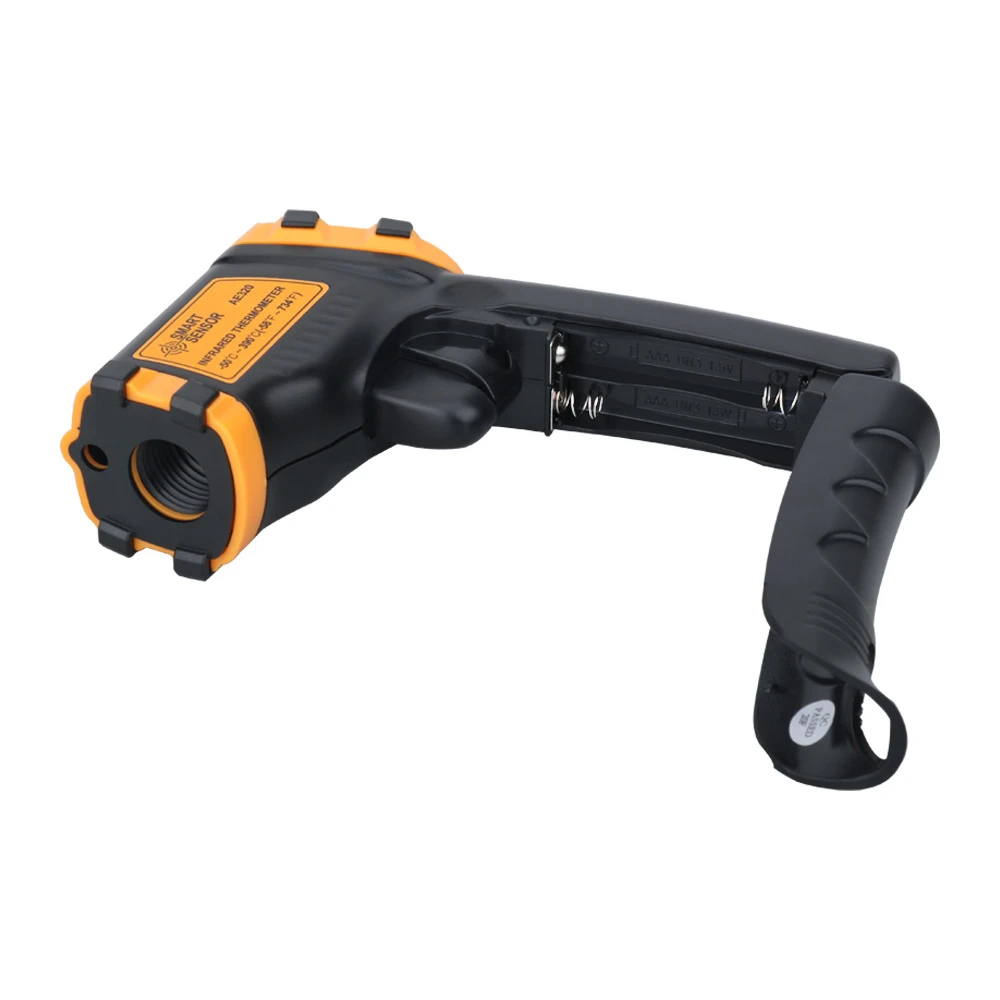
Key points for using infrared thermometer
1. Determine the temperature measurement range
Determining the temperature measurement range: The temperature measurement range is the most important performance indicator of a thermometer. Some thermometer products have a range of -50 ℃ -+3000 ℃, but this cannot be achieved by a single model of infrared thermometer. Each model of thermometer has its own specific temperature measurement range. Therefore, the user's measured temperature range must be considered accurately and comprehensively, neither too narrow nor too wide. According to the blackbody radiation law, the change in radiation energy caused by temperature in the short band of the spectrum will exceed the change in radiation energy caused by emissivity error. Therefore, short waves should be used as much as possible for temperature measurement. Generally speaking, the narrower the temperature measurement range, the higher the resolution of the output signal for monitoring temperature, and the easier it is to solve the problem of accuracy and reliability. If the temperature measurement range is too wide, it will reduce the temperature measurement accuracy. For example, if the measured target temperature is 1000 ℃, first determine whether it is online or portable, and if it is portable. There are many models that meet this temperature requirement, such as 3iLR3, 3i2M, and 3i1M. If measurement accuracy is the main concern, it is best to choose the 2M or 1M model, because if the 3iLR model is selected, its temperature measurement range is wide, and the high-temperature measurement performance is poorer; If users need to take care of low-temperature targets in addition to measuring 1000 ℃, they can only choose 3iLR3.
2. Determine the target size
Infrared thermometers can be divided into monochrome thermometers and two-color thermometers (radiation colorimetric thermometers) based on their principles. For monochrome thermometers, the area of the measured target should fill the thermometer's field of view during temperature measurement. It is recommended that the size of the target being tested exceed 50% of the field of view size. If the target size is smaller than the field of view, the background radiation energy will enter the visual and acoustic symbols of the thermometer and interfere with the temperature reading, causing errors. On the contrary, if the target is larger than the field of view of the thermometer, the thermometer will not be affected by the background outside the measurement area. For colorimetric thermometers, when the field of view is not filled and there is smoke, dust, or obstruction in the measurement path, which can attenuate the radiation energy, it does not have a significant impact on the measurement results. For small targets that are in motion or vibration, a colorimetric thermometer is the best choice. This is due to the small diameter and flexibility of light rays, which can transmit light radiation energy through curved, obstructed, and folded channels.
For some thermometers, their temperature is determined by the ratio of the radiated energy within two independent wavelength bands. Therefore, when the target being measured is small and not filled with the field, and there is smoke, dust, or obstruction on the measurement path that attenuates the radiation energy, it will not affect the measurement results. Even in the case of energy attenuation of 95%, the required temperature measurement accuracy can still be guaranteed. For targets that are small and in motion or vibration; Sometimes targets that move within the field of view or may partially move out of the field of view, under these conditions, using a dual color thermometer is the best choice. If it is impossible to directly aim between the thermometer and the target, and the measurement channel is bent, narrow, or obstructed, a dual color fiber optic thermometer is the best choice. This is due to its small diameter, flexibility, and the ability to transmit optical radiation energy through curved, obstructed, and folded channels, making it possible to measure targets that are difficult to approach, have harsh conditions, or are close to electromagnetic fields.