Main Components of Metallographic Microscopes
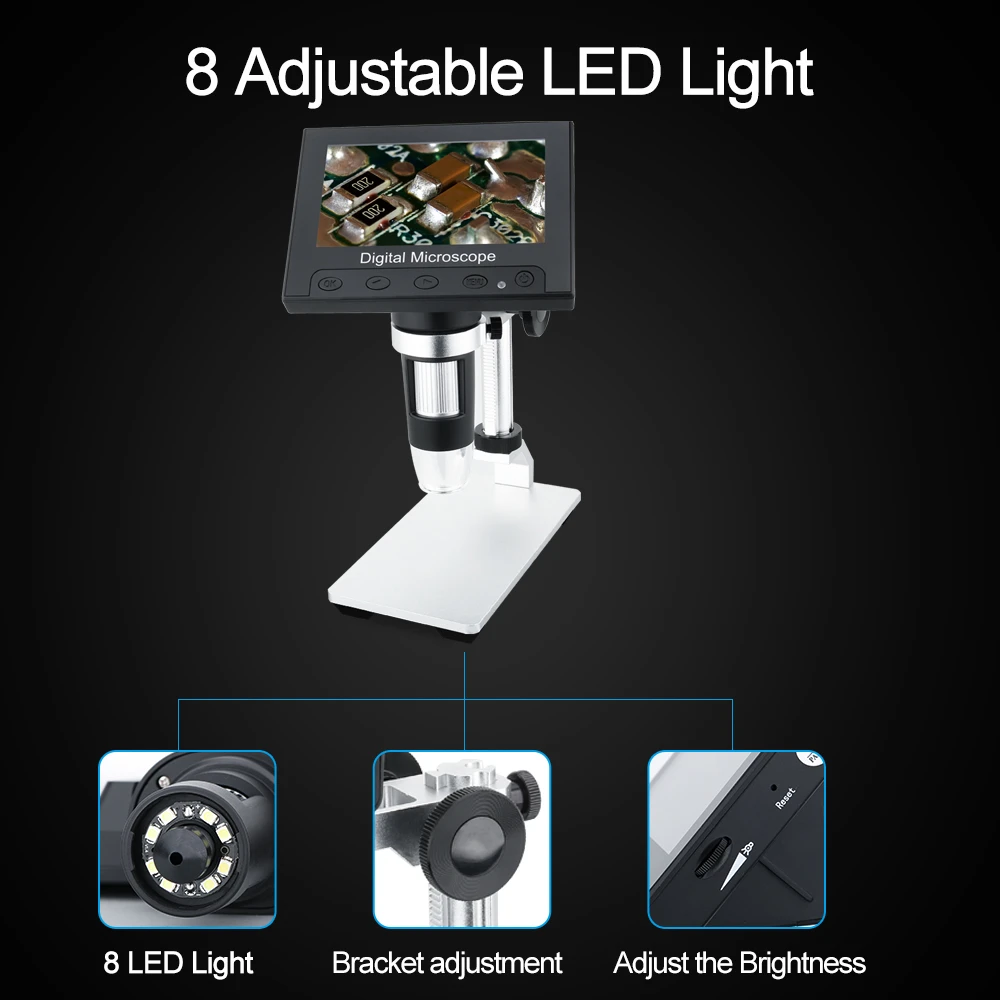
① Base: It is the base of the entire metallographic microscope, usually horseshoe-shaped or rectangular, to support and stabilize the whole instrument. Some microscopes are fitted with an illumination device inside the base.
② Pillar: The upright section above the base, used to connect and support the arm.
③ Arm: The curved section extending upward from the pillar. When carrying the microscope, hold this part. Some microscopes have a movable joint between the arm and the pillar, known as an inclination joint, which allows the arm to tilt backward for observation.
④ Tube: Attached to the front of the arm, generally 160 mm long. Some tubes are fixed, while others can move up and down. An eyepiece is mounted on the top of the tube, and an objective nosepiece is connected at the bottom.
⑤ Adjustment Knobs: Two types of large and small screws installed on the arm or tube. Rotating them moves the tube or stage up and down to adjust the distance between the objective lens and the specimen, namely focusing. The coarse focus knob has a large vertical travel range when rotated. It can quickly adjust the distance between the objective and specimen to bring the specimen into the field of view. The fine focus knob provides a small lifting range. It is generally used for fine adjustment after coarse focusing or under high magnification to obtain a sharp and complete image, and to observe structures at different depths of the specimen.
⑥ Objective Nosepiece (Revolving Nosepiece): A rotatable disc mounted at the bottom of the tube, with 3–4 circular holes for mounting objective lenses of different magnifications. When an objective lens is rotated into the working position (aligned with the optical axis), the notch on the edge of the nosepiece must lock into the fixed buckle on the base; otherwise, observation cannot be performed.
⑦ Stage of Metallographic Microscope: A square or circular platform below the tube for placing specimen slides. A circular light transmission hole is located in the center of the platform, through which light from below irradiates the specimen. A slide holder is fitted on the stage. Its curved spring on the left secures the specimen slide. Two screws on the right can move the specimen forward, backward, leftward and rightward. Some holders are engraved with scales to measure the moving distance and position of the specimen.