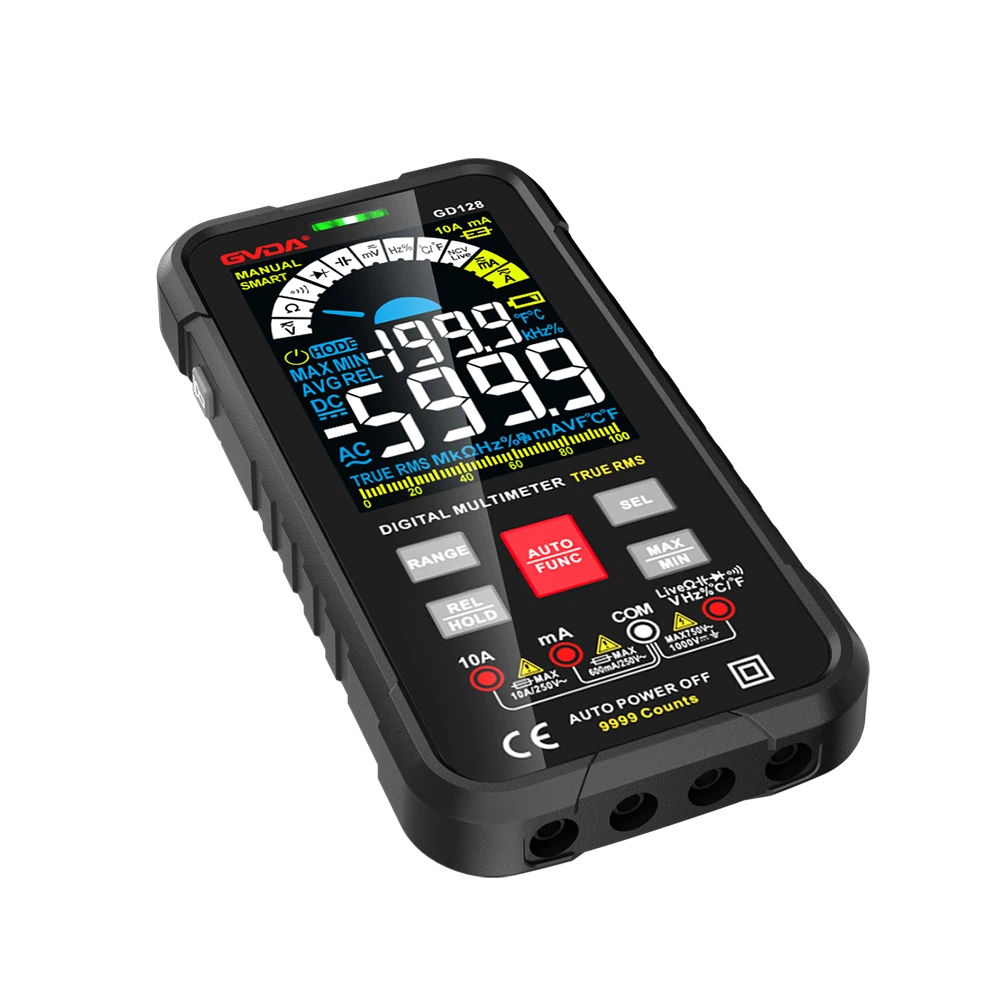
Measurement and Precautions of Capacitance File of Multimeter
Capacitance (or capacitance, Capacitance) refers to the amount of charge storage under a given potential difference; it is denoted as C, and the international unit is Farad (F), which is a physical quantity that characterizes the ability of a capacitor to hold charges.
1 farad (F) = 1000 millifarad (mF) = 1000000 microfarad (μF)
1 microfarad (μF) = 1000 nanofarad (nF) = 1000000 picofarad (pF)
How to judge the quality of the capacitor?
Use the ohm gear of the pointer multimeter (the gear position is adjusted according to the capacitance), discharge the capacitor first, and then touch the two pins of the capacitor with the two pens. The pointer will swing to the farther position and quickly return to the original position. If the pointer swings and cannot return to the original position, the capacitor is leaking (it is normal for a large-capacity electrolytic capacitor to have a slight leak). If the pointer does not move, it means that the capacitor is broken (the capacity is too small, such as a few PF, which cannot be measured. I use the 10K file to measure the smallest capacitor with a capacity of 3N3, 4N7, etc.).
The method of measuring whether the capacitor is leaking
For a capacitor above 1,000 microfarads, you can use the R×10Ω file to quickly charge it first, and initially estimate the capacitance, and then change to the R×1kΩ file to continue measuring for a while. At this time, the pointer should not return, but should stop at Or very close to ∞, otherwise there is leakage. For some timing or oscillating capacitors below tens of microfarads (such as the oscillating capacitors of color TV switching power supplies), the requirements for their leakage characteristics are very high. As long as there is a slight leakage, they cannot be used. At this time, they can be charged at the R×1kΩ level. Then use the R×10kΩ file to continue the measurement, and the hands should stop at ∞ and should not return.