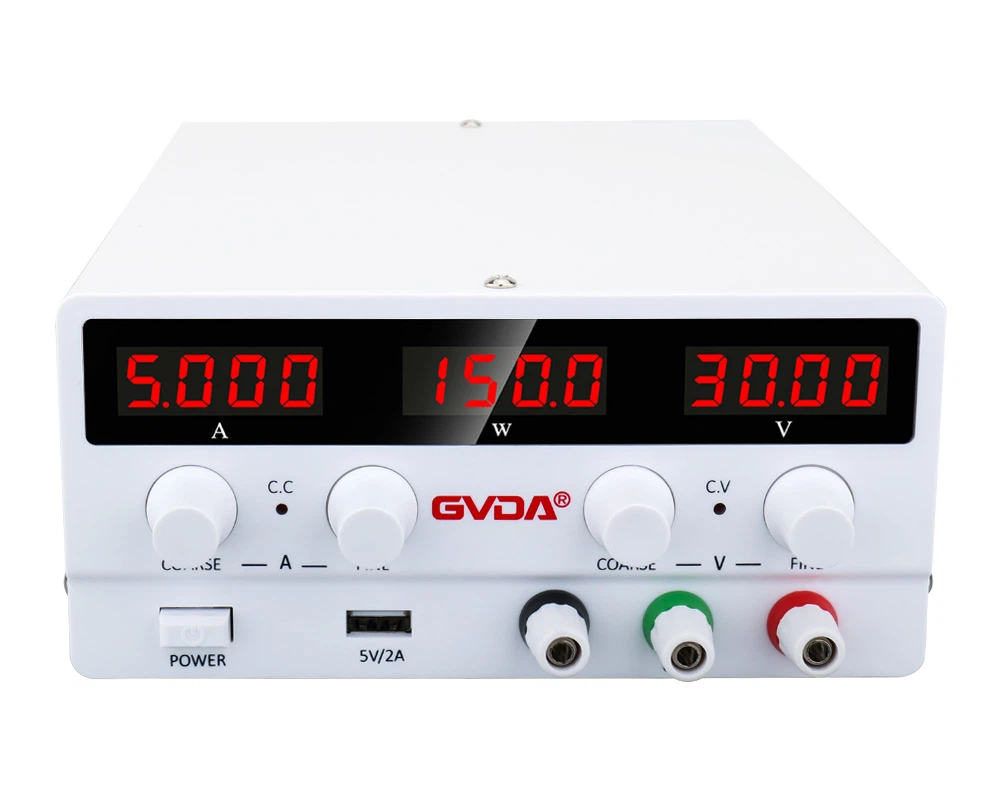
Measurement of Transient Response of DC Stabilized Power Supply
Transient Response Specifications
The transient response of the regulated power supply can be divided into: source transient response and load transient response. Generally, recovery time is used as a technical index to measure the quality of transient response.
1 Source Transient Response
The recovery time is used as the indicator of transient response, that is, when the AC power supply voltage changes step by step, the output voltage of the stabilized voltage source
U is the time Δ from the beginning of the step to the final regression within the allowable error band ( U - ΔU , U + ΔU )
tS . During the measurement, for the convenience of observation, let the amplitude of the AC power supply voltage change as follows: 198 V → 220 V → 242 V → 220 V → 198 V, and the cycle changes. The rise time of the supply voltage step should be less than 1/10 of ΔtS.
2 Load transient response
The recovery time is used as the indicator of the transient response, that is, when the load current changes stepwise, the time ΔtZ of the output voltage U of the stabilized voltage source from the beginning of the step to the final return within the allowable error band (U - ΔU, U + ΔU), such as Figure 2 shows. During the measurement, for the convenience of observation, let the amplitude of the load current change as follows: (0.5~1) Ib→0.1 Ib→(0.5~1) Ib→0.1 Ib, changing periodically.
Among them, Ib is the maximum output current of the regulated power supply, and the upper limit of the load current is (0.5-1). Ib is determined according to different requirements. The rise time of the load current step should be less than 1/10 of ΔtZ, and the holding time of each step should be greater than 5ΔtZ.
3 Technical indicators of transient response
The technical indicators of source transient response and load transient response are respectively given in the product technical manual, expressed by the following three parameters:
1) Allowable error band: In Figure 1 and Figure 2 (U - ΔU, U + ΔU) represents the allowable error band, and the value of ΔU is clearly given in the technical manual.
2) Recovery time: from the start of the step, the time for the output voltage to finally return to the most allowable error band. The output voltage repeatedly crosses the allowable error band through multiple oscillations, and is calculated by the time when it enters the allowable error band for the last time. The value of Δt is clearly given in the technical manual.
3) Peak voltage: The maximum magnitude of the output voltage deviating from the steady-state output value due to a step change in the load or source, which includes positive peaks and negative peaks, but this indicator is not required in many technical manuals. If the user cares about this index, it can be given as needed during measurement.