Measuring principle of illuminance meters and the species involved
Measuring Principle
A photovoltaic cell is a photoelectric element that directly converts light energy into electrical energy. When light is directed to the surface of the selenium photocell, the incident light passes through the metal film 4 and reaches the dividing surface of the semiconductor selenium layer 2 and the metal film 4, generating a photoelectric effect at the interface. The size of the generated photogenerated current has a certain proportionality to the illumination on the light-receiving surface of the photocell. At this point, if an external circuit is connected, a current passes through, and the value of the current is indicated from a microampere meter graduated in lux (Lx). The magnitude of the photocurrent depends on the intensity of the incident light. The illuminance meter has a variable-speed device, so that it can measure high illuminance as well as low illuminance. Cite the type of illuminance meter:
1. visual illuminance meter: inconvenient to use, high precision, rarely used 2. photoelectric illuminance meter: commonly used selenium photocell illuminance meter and silicon photocell illuminance meter
Types involved
1. Visual illuminance meter: inconvenient to use, not high precision, rarely used
2. Photoelectric illuminance meter: commonly used selenium photoelectric cell illuminance meter and silicon photoelectric cell illuminance meter
Composition and use of photoelectric cell illuminance meter requirements:
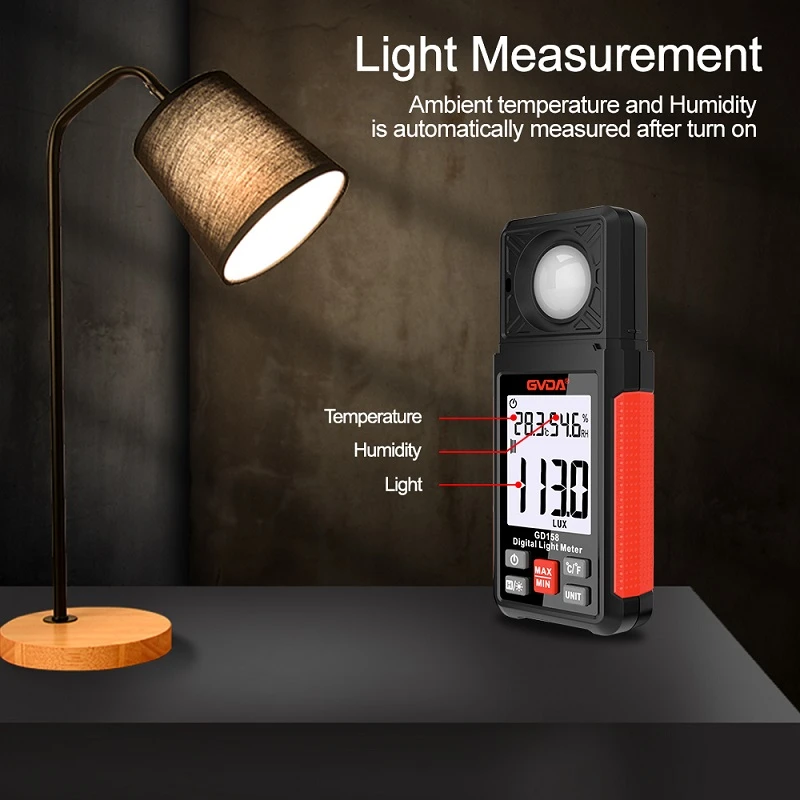
1. Composition: microampere meter, shift knob, zero adjustment, terminal, photocells, V (λ) correction filter and other components.
Commonly used selenium (Se) photocells or silicon (Si) photocells illuminance meter, also known as lux meter
2. Use requirements:
Illuminance meter probe is made of glass, easy to fall and break, while the use of waterproof effect is very poor
① photocell application of good linearity of selenium (Se) photocells or silicon (Si) photocells; long working hours can still maintain good stability, and high sensitivity; high E when the choice of high-resistance photocells, its sensitivity is low and linear, not easy to be damaged by bright light irradiation
② paid within the V (λ) correction filter, suitable for different color temperature light source illumination, the error is small
③ photocell before the addition of a cosine angle compensator (opal glass or white plastic) because the incident angle is large, the photocell deviates from the cosine rule
④ illuminance meter should work at room temperature or near room temperature (photocell drift with the temperature change and change)