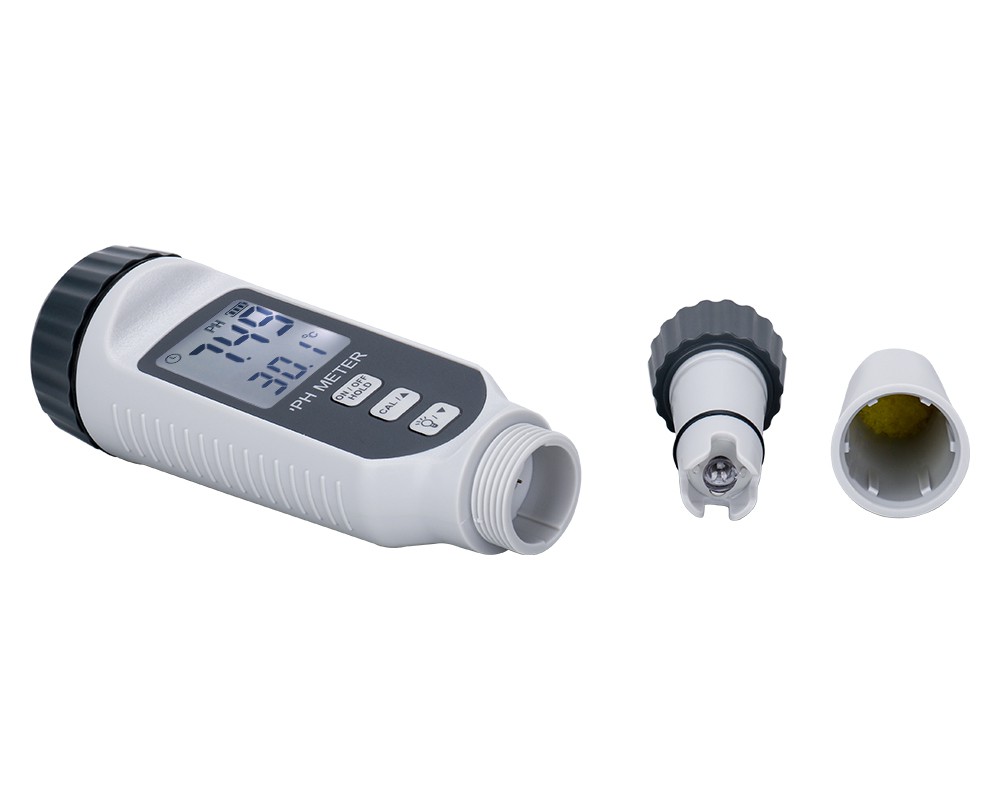
Measuring principle of non-contact acid and alkali concentration meter
A non-contact acid and alkali concentration meter, the principle of which is to use electromagnetic induction to measure conductivity. Two mutually insulated toroidal inductance coils are solidified together, and the holes are connected. If the two wires of the above structure are placed in the measured liquid, the measured liquid must pass through the communication holes of the two coils. Since the measured acid and alkali solutions are dielectric and conductive, the liquid can be regarded as an analog Conductor, this simulated conductor passes through the loop coils Ll and L2, thus forming an equivalent circuit for measurement. In the equivalent circuit, the simulated conductor is the measured liquid and is conductive, so it can be regarded as a single-turn coil with a certain resistance. Passing through the L1 magnetic ring, there must be an induced current in the analog conductor, and the analog conductor also passes through the L2 magnetic ring, so the output signal must be induced in the L2 coil. When the magnitude of the input signal in L1 is determined, the magnitude of the output signal will vary with the magnitude of the current in the analog conductor. Since the simulated conductor is the measured liquid, its conductivity is proportional to the acid and alkali concentrations of the measured liquid, so by detecting the magnitude of the output signal of L2, the magnitude of the current in the simulated conductor can be measured, so the simulated conductor is measured Conductivity - the acid and alkali concentration of the measured liquid.